In a circular economy, solutions are often spread across the entire value chain: moving ahead with them requires a combination of collaboration, sustainable (product) design, circular business models and processes and the ability to convince others that this whole complex process is necessary. This demands knowledge of the circular economy and the skills to turn that knowledge into action to initiate change within organisations.
The Circular Ambassador Programme was set up to shape ambitious professionals into Circular Ambassadors. This session will focus on training future trainers.
The 1st International Congress on Algae Biotechnology will bring together a dynamic mix of researchers, industry leaders, entrepreneurs and policy makers to shape the future of algae innovation.
Organised by PROALGA and GreenCoLab, this event will explore groundbreaking advances and practical applications of algae in sustainability, health and industry. Come and find out about the latest research, discover disruptive technologies and network with pioneers shaping the algae ecosystem!
This CEPS In-Depth Analysis examines the role, state of play and future prospects of standardisation of critical raw materials (CRM) from an EU perspective.
It begins with an overview of the key benefits and actors in both the EU and global technical standardisation system.
It then maps key recent developments and initiatives in CRM standardisation, in the EU and globally. Drawing on consultations with experts, it identifies three fundamental risks and challenges: the limited participation of EU stakeholders and experts, specific content gaps in recycling and traceability, and a highly fragmented ESG standardisation landscape.
Lastly, it provides policy recommendations to help address these challenges and enhance the EU’s role in CRM standardisation.
The World Circular Economy Forum is one of the biggest circular events of the year. WCEF2025 will take place in São Paulo, Brazil on 13-16 May under the heading Tropical solutions for sustainable growth!
The programme has now been released, with a rich selection of plenaries and parallel sessions.
The topic this year is Circular solutions for a competitive EU.
On 3-4 June, the conference will feature high-level debates on policy aspects of circular economy. On 5 June, in-depth discussions among stakeholders will focus on unleashing the circular economy’s potential for a competitive and resource-efficient Europe.
This year, the European Roundtable on Sustainable Consumption and Production will focus on Multi-stakeholder cooperation on sustainability: Role of business, academia, public sector and civil society in Sustainable Consumption and Production.
The Basque Government has approved a list of 64 clean technologies eligible for tax deductions amounting to 30% of the investment. The goal is to make production processes more efficient by using equipment with a high environmental performance and so accelerate the climate and circular transition of SMEs in the Basque Country.
Re:inventex is carrying out a project for the recycling of post-industrial and pre-consumer textile waste. It is essentially the first pilot project in Ukraine to create a modern infrastructure for the collection, sorting and recycling of textile waste.
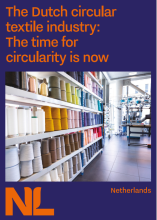
This publication featuring Holland Circular Hotspot shows the state of play and potential of circularity within the textile value chain in the Netherlands and beyond.
It aims to engage international dialogue on accelerating the transition to a fully circular textile economy, with policymakers, researchers, entrepreneurs, consumers and investors.
The challenges of achieving sustainability and circularity in textiles are complex and interconnected, from reducing environmental impact to improving labour conditions. This underscores the importance of international and multi-stakeholder collaboration to drive innovation, scale up sustainable practices and create a thriving circular textile industry.
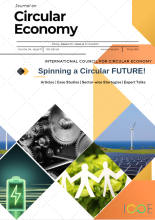
The Journal on Circular Economy is an initiative by the International Council for Circular Economy (ICCE). The journal explores various dimensions of the circular economy, including policy frameworks that support sustainable practices, research initiatives that drive innovation, and collaborative efforts that foster knowledge sharing among stakeholders.
The January 2025 edition features an article by Freek van Eijk from Holland Circular Hotspot, one of the ECESP Coordination Group co-chairs. The article focuses on the Netherlands: embracing circular economy as a business opportunity and a necessity. It looks at the origin and future of circular economy developments there and what lessons might be learned for India.