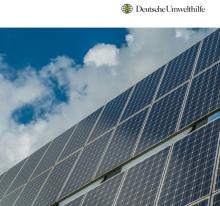
Every year, huge numbers of photovoltaic (PV) modules are being installed. This solar energy expansion greatly furthers the ecological transformation of the energy system. But to solve the climate crisis every aspect has to be taken into consideration. This is why this white paper wants to shine light on challenges currently occuring or to be expected in connection with used photovoltaic modules and their disposal in Germany.
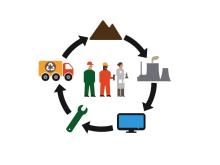
To better implement the goals of a circular economy, this paper will retrace the steps in the lifecycle of a photovoltaic module and analyse problems and possible solutions along these stages. After a brief description of the occuring challenges, opportunities and solutions deemed to be effective and sensible in these matters are presented.
By designing and enabling the use of Electric Vehicle (EV) batteries for multiple use-cycles, valuable materials are maintained, and a range of economic and environmental benefits can be unlocked.
Innovators from the automotive industry, Dutch and French public authorities, and the European Commission have collaborated to identify regulatory barriers to reusing EV batteries as energy storage devices and unlock solutions.
Circular Valley aims to establish a future-oriented circular economy.
It was founded in 2021, and already over 100 startups from all around the world have participated in its Circular Economy Accelerator.
It is funded by the North-Rhine-Westphalian Ministry of the Economy with a view to leveraging and developing the region's strengths through innovative circular economy concepts, products and business models.
Members can connect up with 140+ partners from industry, R&D and government from the Circular Valley network. The platform also organises expert workshops, tailor-made training sessions and an intensive coaching and mentoring programme.
Discover the ECESP Coordination Group's work plan 2021 which aims to advance the circular economy and bring the community together. The Group members will use their expertise and tackle issues in eight areas identified as being key for the transition to a more circular economy.
Welcome to the circular economy event of the year, World Circular Economy Forum 2021, on 13-15 September 2021!
Hosted for the first time in North America, WCEF 2021 will focus on the system level changes, or “game changers,” needed to accelerate the transition to a circular economy.
The Italian company CIA has found that the most appropriate way to reuse coffee husks is as a fertiliser and soil conditioner by composting them in organic farms.
Dienpi S.r.l. produces labels, tags and packaging for fashion brands. The production of tags and packaging for luxury brands whose production processes are not traditionally linear involves considerable amounts of innovation, sustainability and craftsmanship.