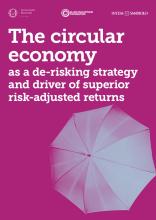
Bocconi University’s analysis of 200+ European, publicly listed companies across 14 industries shows that the higher the circularity of a company, the lower its risk of defaulting on debt, and the higher the risk-adjusted returns on its stock.
The paper reveals how circular economy strategies can reduce investment risk by decoupling economic growth from resource consumption, diversifying business models, and allowing businesses to better anticipate stricter regulation and changing customer preferences. Embedding circular economy principles also reduces exposure to supply chain disruptions and volatility of resource prices.
Regenerating nature requires an economic transformation. To halt and reverse biodiversity loss, we need to fundamentally transform the way we produce, use, and consume our products and food. Conservation and restoration efforts alone – crucial though they are – will not be enough. The circular economy offers a framework for such a transformation. Applied together, its three principles are able to help tackle the root causes of biodiversity loss and enable the regeneration of nature. These biodiversity benefits can be demonstrated across different industry sectors, as shown in this new study by Ellen MacArthur Foundation. This paper also highlights the key steps businesses and policymakers can take to scale the circular economy potential and help shape a nature-positive future.
Society 2030: Spirit of Progress is Diageo's 10-year action plan to help create a more inclusive and sustainable world. This global leader in beverage alcohol has set itself 25 goals aligned to the UN's SDGs.
Given the need totake biodiversity more into account in circular economy projects, this study aims to stress the links between the two and to clarify the role played by the circular economy in preserving ecosystems.
Several guiding circular economy principles contribute to reducing the impacts of our activities on ecosystems, such as non-toxicity, optimisation of resource management, promotion of renewable resources and looping of flows. The study also highlights the fact that each lever for implementing the circular economy can and should factor in biodiversity: land-use planning, normative framework, innovation, awareness raising and training, and economic support.
The brochure Circular Cities shares knowledge and experience of circular solutions from the Netherlands to inform and inspire people and to stimulate international cooperation.
Join the EU ETV programme's online webinar on 29 September to learn how Environmental Technology Verification (ETV) can help innovators, investors and buyers become more familiar with verifying new environmental technologies. ETV seeks to boost the uptake of innovative environmental technologies and to contribute to the circular economy.
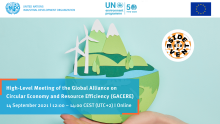
You are invited to follow GACERE's (Global Alliance on Circular Economy and Resource Efficiency) first high-level meeting online on 14 September 2021 in the sidelines of the upcoming World Circular Economy Forum.
Are you an entrepreneur and/or a project leader in the field of circular economy? Is your project less than three years old and are you still looking to refine your business model? Do you want your project to have a positive impact? Do you need to better understand and identify the opportunities and threats? Submit your project to Circulab!