Are you involved in a local circular economy activity? Join the Hubs4Circularity Community of Practice launch event on 24 February to learn about our opportunities in advancing circular value chains, and help us shape our new knowledge platform to meet your needs.
The World Circular Economy Forum 2023 will be held in Helsinki from 30 May to 2 June 2023. This global collaboration forum is co-organised by Finnish Innovation Fund Sitra and Nordic Innovation, with international partners. It will attract more than 2 000 leading circular economy players in the world to Finland to find circular solutions that can help our economies fit within the boundaries of nature. Part of the programme will also be accessible online.
The report Twin Transition in the Wood-Furniture Value Chain - State-of-the-art on Environmental Certifications Practices and Industry 4.0 in the Wood and Furniture Sector provides an overview of the current environmental and digital trends and practices affecting the wood value chain in its entirety. Taking a value chain perspective, the report outlines regulatory trends, new digital and technological developments, and emerging practices that will affect the sector as a whole.
By deploying smart systems and new production processes, European SMEs can optimise their usage of raw materials, improve their waste management and contribute to the development of a circular economy.
The ECESP is pleased to share with you the issue paper assembling the key takeaways of the November 2022 event How can EPR promote sustainable consumption and production?
IMPACT Furniture is part of Oxfam Belgium. Through its Upcycle Your Office project, it is in the process of developing a catalogue of upcycled office furniture.
The plywood panels are recovered from old office furniture thrown away by local businesses and organisations and subsequently used as a raw material for making new furniture items.
The profits are ploughed back into Oxfam Belgium and help finance projects to fight poverty.
The roadmap for Ostrobothnia (Finland) provides practical examples on how to get started or develop sustainable thinking, based on the latest research and current trends. The focus is on developing concrete guides, tools and checklists to make the change easier for entrepreneurs.
Get started - Focus on sustainability
Facilities & energy - Less is more?
Raw materials - Everything starts from the choice of materials
Design & product development - Right from the start
Purchases - Have courage to set strict requirements
Production & manufacturing - Produce for the future
Transports & distribution - The closer the better
Communication & marketing - Tell!
Sales - New requirements
Waste & recycling - Go through your waste recycling
Annual Conference 2023: Recovery, Open Strategic Autonomy and Resilience
The European Commission and the European Economic and Social Committee will host the 2023 European Circular Economy Stakeholder Conference on 27 and 28 February 2023.
The Circular Navarre Catalogue 2022 is an update of the showcasing booklet published in 2020 and in 2021. This new edition includes 50 organisations - based on circular business models - in the Spanish Navarre region, looking for international cooperation.
At the request of the European Commission, the European Environment Agency (EEA) has produced EU country profiles that offer an updated view of circular economy policies being implemented at a national level, with a particular focus on elements that go beyond EU mandatory elements, and best practice with a focus on policy innovation.
While implementing the EU Circular Economy Action Plan (CEAP 2020), Member States are encouraged to advance circularity at a national level by adopting policies and initiatives that go beyond EU regulations, while preserving the Single Market.
These circular economy country profiles are based on information reported by the Eionet network and, particularly, its Group on Circular Economy and Resource Use in the second quarter of 2022.
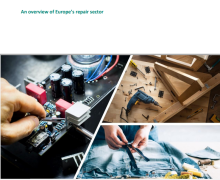
Repair is one of the key circularity strategies. It can lead to extended product use and efficiency, reduced consumption of natural resources and materials and minimised waste production.
The importance of this sector has been acknowledged in several of the European Commission’s strategic documents, such as the European Green Deal and the Circular Economy Action Plan.
The aim of this report is to consolidate and advance the existing knowledge, and provide an evidence-based update on the status of the repair sector in Europe. It focuses on three key product groups:
electrical and electrical equipment (EEE),
clothing and
furniture.
It also provides an overview of the value, size, challenges and opportunities of current repair activities in these sectors.