The University of Cambridge (UK) is running a sector-wide workshop on "Speeding up the Transition to Closed Loop Synthetic Fibre Recycling by 2030". It will help industry experts and policy makers co-create strategic policy solutions on how to speed up the transition away from the use of virgin and non-closed loop sources of synthetics towards a full closed loop textile recycling system across the European Union.
The workshop will be held online from 11:00 to 15:00 (London time) on Tuesday 28 February 2023.
The European Commission is conducting a survey on possible new legislation on the management of plastic pellets, with a view to reducing the amount which ends up in the environment.
This survey is only for companies handling plastic pellets in the European Union, in particular small and micro-companies. It will close on Thursday 23 February.
The European Commission, with Studio Feschi&Soci, Green Soluce, Alda and ACCIO, is organising a capacity-building event on the Environmental Footprint methods on Tuesday 28 February 2023 from 10:00 to 14:00 CET in Barcelona, Spain.
This will be a local event held mainly in Spanish, but it will be organised in hybrid format to enable remote participants to join.
On Day 2 of the European Circular Economy Stakeholder Annual Conference (28 February), a Networking Village will showcase a selection of good practices, initiatives and circular business models. Twenty online and ten on-site exhibitors will bring their work to an audience of around 500 participants. A unique opportunity to pitch projects and matchmaking opportunities. Interested?
The EU is facing increasingly serious societal, environmental and climate challenges. EuRIC is uniquely placed to bridge circularity and climate neutrality. However, regulations and policies are hindering the sector's ability to tackle these societal challenges in partnership with the EU.
Join EuRIC in Brussels on 30 March for a high-level conference that will unite European policymakers and recycling experts from across the circular economy value chain.
On 31 January, the Commission launched an online public consultation on what the new product priorities under the proposed Ecodesign for Sustainable Products Regulation (ESPR) should be.
The aim is to make products on the EU market increasingly sustainable, by enabling far-reaching performance and information requirements – known as "ecodesign requirements" – to be set on a wide range of them to improve their circularity, energy performance and other environmental sustainability aspects.
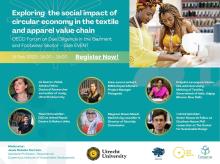
Circular economy take-up by companies in the textiles and apparel sector has increased significantly in recent years, but we know relatively little about how current circular business models affect workers and communities.
In this session on 14 February, Utrecht University's Copernicus Institute of Sustainable Development, Smart Green Industry and Conserve India will explore the outcomes of their most recent social impact study on the apparel value chain.
The ASEAN Circular Economy Stakeholder Platform (ASEAN CE Platform) is a regional facility helping Association of Southeast Asian Nations Member States achieve sustainable consumption and production by accelerating the transition to a circular economy.
The EU-ASEAN Strategic Partnership covers the circular economy, and the Platform is part of the EU-ASEAN Partnership on Circular Economy, endorsed by ASEAN Senior Officials on the Environment in 2018. The ASEAN CE Platform is hosted by the ASEAN Centre for Sustainable Development Studies and Dialogue at the College of Management, Mahidol University in Bangkok, Thailand.
The establishment of the Platform was inspired by the success of the European Circular Economy Stakeholder Platform in providing access to CE good practices and strategies.
The European Commission's Horizon Europe Framework Programme has launched a call for the circular economy and bioeconomy sectors, with particular reference to circular systemic solutions under the Circular Cities and Regions Initiative (CCRI).
In this context, a circular systemic solution is defined as a demonstration project for deploying a circular and climate-neutral economy at urban and/or regional scale, involving key stakeholders and, ideally, addressing more than one product value chain. Proposals are expected to implement and demonstrate at large scale circular systemic solutions for the deployment of the circular economy (including the circular bioeconomy) in cities and regions or their groupings. They should form part of the implementation of the European Commission's Circular Cities and Regions Initiative (CCRI) and should be carried out in close coordination and cooperation with the CCRI Coordination and Support Office (CCRI-CSO).