On 17 July 2024, the Catalan government launched the Roadmap for the Circular Economy in Catalonia (Full de Ruta de l’Economia Circular a Catalunya, FRECC), highlighting its push for sustainable development and accelerating the transition to a more circular and equitable economy that maximizes the value of resources by 2030.
The plan, developed by the Catalan government (Generalitat de Catalunya), experts and citizens, aims to decouple economic growth from resource consumption and greenhouse gas emissions.
The roadmap will be implemented by means of two action plans: one for 2024-2026 and another for 2027-2029.
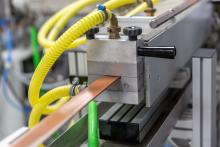
The RECERCO project recovered fired sherds, a form of waste generated when manufacturing ceramic tiles. It proved that it is feasible to use this as a secondary raw material for manufacturing new ceramic tiles and as a reinforcement agent for polymeric matrices to obtain composites for the construction industry.
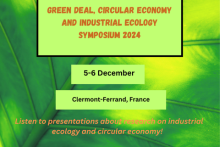
The Green Deal, Circular Economy and Industrial Ecology Symposium 2024 will take place on 5-6 December at the MSH Clermont in Clermont-Ferrand. It will bring together researchers and practitioners who will present their research on industrial ecology and circular economy.
The European Sustainability Congress 2024 is one of the biggest international events focusing on the circular economy and sustainable development.
It aims to promote the idea of the circular economy, support sustainable business models and establish cooperation between interested stakeholders. The Congress will be the focal point of Circular Week 2024 and is organised by INNOWO - Institute for Innovation and Responsible Development and Polish Circular Hotspot, in cooperation with the European Circular Economy Stakeholder Platform.
ETRA, the European Tyre Recycling Association, and AIMPLAS, the Plastics Technology Centre, are organising an international workshop exploring rubber recycling, polymer technology and EU-funded projects.
It will address various challenges in the elastomeric materials sector by providing a dynamic platform for sharing knowledge and exploring opportunities. There will be a pitch session, where experts will consider each participant's project, and sessions on issues such as Market analysis: challenges, opportunities and limits in the recycled rubber industry.
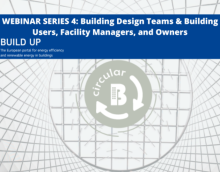
BUILD UP, the European portal for energy efficiency and renewable energy in buildings, is hosting the fourth in a series of six webinars organised with the CircularB COST Action project. This one will focus on Building Design Teams and Building Users, Facility Managers and Owners.
Wales (Cymru in Welsh) will be hosting the 2024 European Circular Economy Hotspot: Circular Economy Hotspot Cymru in Cardiff on 7 - 9 October.
This summit will be an opportunity to find out about Wales' circular economy achievements and aspirations, and learn about circular economy solutions from the public sector, private sector and communities from Wales and beyond. Participants will be able to engage with Welsh projects across industry, business, public bodies, academia, and towns and cities.
There will be global circular economy innovators, leaders and thinkers, so it's a good chance to forge links and network.
CEWEP, the Confederation of European Waste-to-Energy Plants, will be holding its international conference on residues from waste-to-energy on 25 September in Mechelen, Belgium. Residue experts from across Europe will tackle topics such as environmental contribution, residue utilisation and material recovery.
There will be ample opportunity for networking during the breaks and the buffet on the evening of 25 September. On 26 September, participants can visit Indaver’s ash treatment facility.
This year, the International Day of Awareness of Food Loss and Waste will be celebrated on 27 September. Get involved in the campaign by sharing free materials on digital channels and spread the word!