ROCESP members include local and central government institutions, academic, research and innovation institutions, businesses and civil society representatives.
The platform acts as a network of networks, bringing together initiatives, experiences, problems and expectations in the field of the circular economy.
The platform:
disseminates knowledge
promotes dialogue and synergies between Romanian stakeholders
maps good practices in Romania
helps establish links between national projects
shows how Romania has adapted its economy to become more circular.
The EU-funded OLEAF4VALUE project set up a consortium of highly experienced partners to develop a valorisation system for the olive leaves biomass. The consortium addressed all levels of the value chain: raw material, biorefining, post-extraction technologies, market validation and sustainability assessment.
Ireland is at a turning point for the transition to a circular economy (CE). The 2022 Whole of Government Circular Economy Strategy provides the policy framework for the CE in this country, and the forthcoming Circular Economy Bill is expected to strengthen waste and CE legislation.
Nevertheless, with a circularity material use rate of 2% in 2020, Ireland shows significant scope for progress. This report analyses the state of play and challenges of the circular transition in Ireland and provides policy recommendations for CE policy across levels of government. It is the result of a two-year policy dialogue between the OECD, the Department of the Environment, Climate and Communications, as well as a broad range of public, private and civil society stakeholders.
The HOOP Network of Cities and Regions seeks to facilitate the exchange of knowledge and mutual learning among cities and regions willing to recover valuable resources from urban bio-waste and wastewater to make bio-based products.
By joining the network, cities and regions gain information about innovative urban bioeconomy solutions and engage in activities relevant to their context and specific interests. Participants have direct exchanges with the eight HOOP lighthouse cities and regions, sharing experiences and expertise.
The HOOP network is only open to organisations that plan, organise or operate municipal waste management or wastewater treatment activities, for instance local or regional authorities and waste management companies.
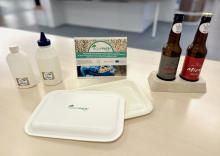
The BioSupPack project aimed to deliver novel, cost-competitive and versatile bio-based packaging solutions - based on PHA - that demonstrate high-performance for the packaging of food, cosmetics, homecare and beverage products as well as no environmental damage during and after use.
Russia is among the larger suppliers of raw materials to the EU. It is the biggest world supplier for palladium, platinum and nickel, and a prominent one for aluminium and copper. The country still holds large untapped reserves of rare-earth elements.
This paper provides an overview of EU import dependency on raw materials and Russia’s share among EU sources of key supplies for low-carbon technologies. It then looks at prospects for meeting future material demands through circularity for three technologies, namely lithium-ion batteries, wind turbines and fuel cell electric vehicles.
The analysis is based on two scenarios with different levels of ambition. They aim to give an indication of the scale of potential benefits that can be achieved through circular approaches.
What are your plans for May? ACR+ will kick off an entire month dedicated to innovation and circular economy in waste management. Through several events, ACR+ will showcase some of its activities and projects fostering innovative approaches and practices to reach a circular economy.