In its position paper, Eurocities aims to contribute to the revision of the EU legislation on packaging and packaging waste by making proposals on:
packaging design (to facilitate separate sorting by citizens, and further dismantling for reuse or recycling, i.e. less complexity in packaging materials)
compostable/biodegradable plastic packaging (citizens cannot distinguish between biodegradable/compostable and more ‘conventional’ ones; the Commission should assess if this packaging can benefit the environment or create more littering and hamper waste collection, reuse and recycling)
reuse and recycling (new legislation should consider EU-wide mandatory labelling to identify packaging as reusable, recyclable or compostable) and
The paper also addresses the impact of changes in the value chains of the lighting sector as a result of embracing circular economy - be it by creating second-hand markets or by adopting lighting as a service business model.
In its conclusion, the paper describes how lighting manufacturers, designers, contractors and clients could work together to ensure that the benefits of the circular economy can be achieved.
The European Committee of Manufacturers of Electrical Machines and Power Electronics (CEMEP) supports the development towards a circular economy (CE), thus actively contributing to more sustainable manufacturing and responsible consumption. This industrial sector follows a business-to-business market model, delivering products for a wide number of economic sectors and applications.
Its three main product groups – electric motors, variable speed drives and uninterruptable power systems – show differences and similarities when it comes to material efficiency, hence the need for sector- or product-specific approaches when pursuing CE.
This position paper describes the CE status of the CEMEP industries and the way forward towards more circularity.
This document is the result of the active involvement of the Interreg MED Green Growth community, together with its projects.
They suggest taking a holistic, integrated and cooperative approach, considering all phases in which the circular economy is structured, all levels (from local to European) and all stakeholders involved in the implementation of circular models.
The policy recommendations are structured into six main areas:
Investments and access to finance
Technological infrastructure
Labour market and employment
Awareness and knowledge
Cooperation among stakeholders and technology transfer
However, on behalf of the European chemical distribution sector, particularly the numerous SMEs it represents, Fecc would like to raise the following points:
increasing recycled content in products while ensuring their performance and safety is paramount
stakeholders from across the board – private companies, academia, and public bodies – can all benefit from circularity in the distribution sector
promoting circular public procurement to empower consumers and public buyers is necessary and must be supported post-COVID-19.
In 2019 the European Commission set out a policy guideline to address global environmental challenges and circularity. EURATEX and its members welcome the ambition of the EU Institutions to change the old way and commit to engage with all relevant parties to deliver and implement a new Textile Strategy to boost the circular economy and be fit for the present and future generations.
This strategy by EURATEX is a starting point, with insights into solutions based on a 14-month consultation with members, involving over 100 companies and key stakeholders, focused on applied circular practices and future opportunities. It prioritises removing barriers to a large-scale uptake of circular economy in textiles, sets out 12 key points and puts forward 38 proposals.
The Alliance for Flame Retardant Free Furniture welcomes the new Circular Economy Action Plan and calls on EU institutions to address the unnecessary use of chemicals preventing circularity and the achievement of climate goals, such as toxic flame retardants in furniture, which endanger people’s and firefighters’ health as they migrate out of products and can lead to increased fire toxicity.
The use of such retardants is a historical, hazardous and ineffective practice which is not proven to reduce the number of fires. It is at odds with circularity objectives and their presence in furniture runs counter to the ambition to introduce and increase circularity.
Ensuring fire safety is a must, but it needs to be done in ways that are not hazardous.
From a circular point of view, the wide range of products considered to be "furniture" and the diverse use of materials in production (e.g. wood, plastics, textile, steel, glass, composites, foam) makes it a complex area to address.
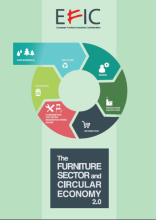
The European Furniture Industries Confederation (EFIC) has drawn up a position paper that identifies challenges and opportunities linked to the circular economy transition, covering the different phases of manufacturing from supply of materials to the end-of-life phase, and that provides sector-specific expertise on EU Circular Economy policies.
The European Manufacturers of Expanded Polystyrene (EUMEPS) is the voice of the Expanded Polystyrene (EPS) industry. It has published an op-ed welcoming the European Commission’s commitment to a Renovation Wave and the outline of its strategy shared in the roadmap published in May 2020. It believes that this initiative is a great opportunity for scaling-up current renovation rates and EU’s climate and energy efficiency goals.
EUMEPS agrees that increased renovation can be a key contributor to creating jobs and stimulating economic recovery in the context of the COVID-19 pandemic. It embraces the Commission’s finding that buildings are also critical for making circularity work and its objective to implement the Renovation Wave in line with circular economy principles.
A broad coalition of social and environmental NGOs has developed a strategy for sustainable textile, garments, leather and footwear. It looks at the social, environmental and governance implications of the textile sector in one forward-looking document ahead of the comprehensive EU Strategy for Textiles, expected in 2021.
The document aims to contribute to the upcoming comprehensive EU Strategy for Textiles, by providing recommendations on what such a strategy should encompass in order to maintain a high level of ambition. It includes forward-looking proposals on due diligence, product policy framework, waste, unfair trading practices, international trade, support to producing countries, alternative business models and a multi-stakeholder platform.