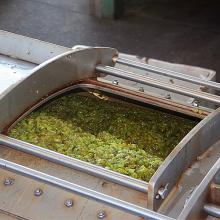
Arany Kapu (in English "golden gate"), a private company in Kunfehértó, Hungary, collects grape processing and winemaking byproducts from all the country's wine regions for valorisation in diverse forms, including distillation.
Re-using textiles locally is the most sustainable way to close the textiles loop as well as to deliver local jobs for the circular and just transition.
Social enterprises in the re-use sector seek to implement the waste hierarchy and abide by the proximity principle. As such, they manage to extend textile products’ lifetime locally while equipping vulnerable individuals with circular skills and building local communities.
This paper by RREUSE outlines good practices in responsible used-textile management carried out by our social enterprises community. It focuses on ways to improve textile collection and local reuse and bolster textile transparency.
This report from the HOOP Project describes the methodological approach for identifying circular business models for bio-waste.
It presents an analysis of the business models behind 15 successful solutions for bio-waste valorisation and proposes a template business canvas for bio-waste valorisation. The report also presents a new integrated circular business model typology focused on bio-waste, along with drivers and barriers related to the implementation of circular business models in bio-waste valorisation.
Each of the eight HOOP Lighthouse Cities and Regions has set up its own local or regional Biowaste Club and carried out its first stakeholder engagement activities through Biowaste Club meetings. While some of these draw on existing local initiatives, others bring stakeholders together for the first time. In some Lighthouses, Biowaste Clubs are accompanied by citizen science activities.
This report documents the stakeholder engagement activities that have taken place so far and what can be expected next.
A Biowaste Club is an institutionalised platform for multi-stakeholder engagement whose members are all local and regional actors along the biowaste value chain, such as waste management companies, research institutions, public authorities, etc.
Biowaste Club meetings take place twice a year, set-up and formats can vary, depending on the local needs and, consequently, on their agenda.
HOOP's Investment Package Manual was developed using a three-step approach and the public version has been distributed in three volumes.
Volume III presents a selection and inventory of funding and financing schemes, programmes, instruments and tools for investment projects on circular bioeconomy and bioenergy at national and regional levels. It provides case studies from eight European countries: Finland, Greece, Germany, Italy, Norway, Portugal, Spain and The Netherlands.
HOOP's Investment Package Manual was developed using a three-step approach and the public version has been distributed in three volumes.
Volume II guides the reader through the selection and inventory of funding and financing schemes, programmes, instruments and tools for investment projects on circular bioeconomy and bioenergy at European level.
HOOP's Investment Package Manual was developed using a three-step approach and the public version has been distributed in three volumes.
Volume I describes the EU Taxonomy concepts as applied to economic activities linked to circular bioeconomy technologies, processes, activities and bioproducts from biowaste and wastewater sludge feedstocks.
The Confederation of Norwegian Enterprises (NHO), the Federation of Norwegian Industries, FoodDrinkNorway, the Norwegian Federation of Service Industries and Retail Trade and the Norwegian Seafood Federation have recently published a report on Extended Producer Responsibility (EPR) as an environmental policy tool.
The report emphasises the main considerations and assessments that should underpin EPR schemes and contributes to the debate on extended producer responsibility as an environmental policy tool in Norway, the EU and the OECD.
This updated playbook by Nordic Innovation, Accenture and Sitra is a guide to circular business models. It is tailored to companies in the Nordic manufacturing industries and describes the key enablers to fully transform and become a circular business.