Fast fashion and disposing of clothes at the end of their lives are generally considered to be the main issues in terms of textile waste. However, pre-consumer waste is another major problem. This occurs a few steps further back in the manufacturing process, and deals with all waste materials created in the supply chain when a product is being made.
Unlike post-consumer waste, it is easier to keep pre-consumer waste away from a landfill or an incinerator as the fabric or garment is essentially brand new, despite one or more repairable defects.
So, finding ways to re-use or use up the resources created is the key to creating an endless supply of materials without further depleting natural resources.
CuCilento (which can be understand to mean both "Sew slowly" and "Sew in Cilento", a region in Campania) is an innovative business project designed by Sarah Khoudja as part of the EU's 'Empowering Women in Agrifood' programme led by the Future Food Institute. It is an upcycling workshop which processes agricultural by-products and other materials (boat sails, factory scraps, etc.) classified as waste and turns them into net or fabric bags that can be used for food packaging or shopping.
At European level, the built environment is responsible for 40% of CO2-eq emissions and roughly 60% of material consumption.
By applying bio-based alternatives to conventional ‘mineral’ construction materials, the environmental impact of the EU27+UK sector can be reduced by 18%.
However, there is a limit to the sustainable wood supply that can be harvested without compromising vital functions provided by forests, and the projected increase in wood consumption is not compatible with the realistic growth potential of harvesting activities. Therefore resource efficiency, bio-based added value or demand for new housing should be carefully weighted in to ensure a sustainable shift, the study concludes.
ecoCEO is an interactive and engaging educational game for the classroom. It increases awareness and transfers knowledge about circular economy strategies and circular business models in a hands-on and fun way. The game is web-based and does not require any prior installation. It is also free to use.
The European Commission has worked on a web-based calculator to increase the awareness of EU citizens on their environmental impact as consumers. The Consumer Footprint Calculator allows EU citizens to calculate the environmental impacts of their consumption pattern, as well as to evaluate how changes in their lifestyle may affect their personal footprint. This tool is available in English, Spanish and Italian.
How can the EU meet its growing demand for critical raw materials (CRMs) through domestic recycling?
This hybrid event on 8 November 2023 (10.30–12.00 CET) at Press Club Brussels (Rue Froissart 95, 1040 Brussels) explores the gaps between EU ambition to ramp up CRMs recycling and the current state of play.
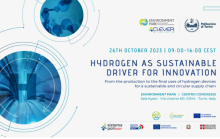
On 26 October, Environment Park in Turin (Italy) will host the event Hydrogen as Sustainable Driver for Innovation - From the production to the final uses of hydrogen devices for a sustainable and circular supply chain.
Taking an overall lifecycle perspective to production, design, manufacturing and the final use of hydrogen devices, this event will explore the sustainability dimension of some of the main steps in the hydrogen value chain.
Health Care Without Harm (HCWH) Europe is announcing a one-day event focusing on Circular Healthcare. Their training session to be held in Brussels on 28 November 2023 is aimed at transforming how to approach healthcare practices and implementing principles from the waste hierarchy in the sector.
Its objectives:
Learn how to reduce plastic and its impacts on health and the environment
Discover how to prevent waste and introduce reusable alternatives in healthcare settings
Explore how to eliminate harmful chemicals from healthcare products and processes
Engage in discussions on sustainable procurement and circular business models for healthcare
Network with fellow Circular Healthcare practitioners and innovators from across Europe.