The Urban Circular Bioeconomy Hub is operated by the HOOP project. It provides resources and tools to improve the exploitation of biowaste and wastewater by cities and regions.
Users can:
network with municipalities and waste/wastewater management companies around Europe.
evaluate their circular performance and the financial attractiveness and maturity level of your circular projects.
make use of resources related to the implementation of urban circular bioeconomy solutions, including handbooks, manuals, factsheets and videos on technologies and financial engineering for circular bioeconomy projects.
get technical support from project developers and investors and mobilise green financing.
register for the forum and put questions to the circular bioeconomy community.
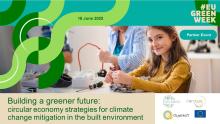
How can the circular economy in the built environment drive climate change mitigation?
During this EU Green Week partner event, experts and stakeholders from three Horizon Europe projects – CIRCOMOD, CircEUlar and CO2NSTRUCT – will discuss innovative circular approaches that can transform the sector.
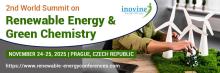
The World Summit on Renewable Energy & Green Chemistry aims to accelerate the adoption of solutions that promote environmental stewardship, energy efficiency and a circular economy.
The call for expressions of interest for the next Coordination Group is now open! The European Commission is launching a call for applications to select members of the Coordination Group of the ECESP.
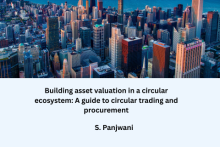
Due to rising demand and shrinking supply, the built environment and its raw material suppliers must align with regenerative cycles. This thesis aims to create a circular procurement framework to determine and preserve building asset value at end-of-life, establishing transparent, measurable standards that reduce waste and optimise resources.
It creates a transparent and measurable standard for the circular procurement process, reducing waste and optimising resource use. The thesis focuses on four major deliverables: a database of site and inventory inspections, an exit scenario and resource recovery plan, a partial deconstruction plan, and an online marketplace for resource trading.
The framework uses existing tools and indicators to establish the circular procurement process.
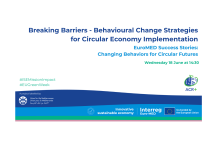
This interactive webinar, organised as part of EU Green Week, will bring together practitioners, experts and researchers to address one of the most challenging aspects of circularity: human behaviour.