The built environment accounts for at least 40% of anthropogenic greenhouse gas emissions. For the Alps, it is key to use local resources effectively while upholding EU rules and promoting the adoption of common standards across the building value chain.
The European Interreg Alpine Space project BAUHALPS is endeavouring to meet these challenges by developing and testing a model that combines New European Bauhaus concepts with sustainability measurements and indicators in an innovative way.
Multilayer packaging, often based on PET and polyolefins, presents significant challenges for recycling due to its complex structure. The EU Horizon project MERLIN has focused on developing cost-efficient and high-performance solutions for sorting, delaminating and recycling multilayer packaging materials.
As the project draws to an end, policymakers, waste management professionals, packaging manufacturers or researchers involved in plastic recycling and circular economy initiatives are invited to take stock of the project's findings.
INN-PRESSME is a consortium of 27 partners from nine countries helping European SMEs and companies develop bio-based solutions in the packaging, energy, transport and consumer goods sectors.
The project will shortly be holding its final event, bringing together investors, industry, policy makers, clusters, universities and research centres. It will be an opportunity to discuss the project results, technologies, market services and lessons learned, focusing on the innovativetest cases.
This analysis report was prepared in connection with the EU-funded Wood2Wood project and explores opportunities to advance the circular economy and overcome challenges to waste wood utilisation through supportive policy.
It outlines recommendations and policy options for improving waste wood utilisation through harmonised multi-criteria waste wood classification, refined and extended targets and obligations, enabling policy and policy which fundamentally reflects the lifecycle perspective. These recommendations and policy options serve as a point of departure to help shape the regulatory environment in support of improved waste wood valorisation.
incommon is a non-profit organisation that encourages people to adopt the circular economy as a way of life. They use a bottom-up approach, working with individuals, schools, businesses, institutions, groups and local authorities.
Their approach ensures that people are informed about circular economy principles and engaged in implementing them, enabling them to make sustainable choices and drive local change.
The European Commission is opening a call for membership applications for a new Ecodesign Forum under the Ecodesign for Sustainable Products Regulation. The forum will play an important role in the implementation of the ESPR by involving all stakeholders in developing rules for more circular, energy-efficient and sustainable products.
The European Commission's Joint Research Centre is organising a second consultation meeting with stakeholders as part of its ongoing work on a preparatory study on textile products. This will support the implementation of the recently adopted Ecodesign for Sustainable Products Regulation.
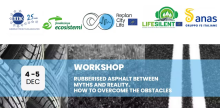
Both the RE-PLAN CITY LIFE and LIFE SILENT projects support the use of recycled rubber in asphalt. Experiences and demonstration projects in various countries have confirmed that this solution is technically viable and more sustainable.
This workshop will involve a visit to an asphalt plant which produces and lays rubberised asphalt and a seminar exploring the most recent experiences and innovations in the use of recycled tyre materials in asphalt and road infrastructure.