In a resource-constrained world the future economy will need to be circular.
From a policy perspective, the question is whether averting catastrophic environmental impacts through an accelerated transition to a global circular economy can also deliver sustained growth and jobs.
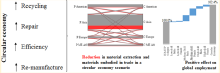
Multiregional input−output (MRIO) analysis models the interdependencies between industries and within/between countries as well as between intermediate and final goods producers and consumers, thus providing a useful toolbox for assessing social, environmental, and economy-wide impacts of the adoption of the circular economy.
This research paper resorts to this toolbox to compare the business-as-usual (BAU) scenario to an alternative circular economy scenario.
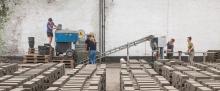
At its production site in Brussels, BC materials blends and transforms ordinary earth streams - what some consider to be waste - into perfectly circular building materials.
Delft University of Technology (TU Delft) is offering a 100 % online course on Sustainable Packaging in a Circular Economy. Students and professionals with basic knowledge of the circular economy and an interest in or experience of packaging can start studying anytime, at the time and place of their choosing. The course material is accessible 24/7. This is a Massive Open Online Course (MOOC) that runs on edX.
The course programme includes:
Business strategies that support sustainable packaging systems
Opportunities for designing with renewable, bio-based materials
Best practices through case studies with industry frontrunners
How circular design principles can be applied to create 'closed loop' packaging systems.
Europe relies heavily on material resources for almost all of society’s activities. Its extraction and production of material resources have significant impacts on the environment and human health, as well as the economy.
It is essential to reuse resources in European economies, keeping their value high, delivering value for longer periods and reducing the need to use virgin materials. While progress is being made in Europe, by implementing an ambitious waste policy and the Circular Economy Framework, significant amounts of valuable resources are still lost through inefficient waste management practices.
This briefing describes material losses in Europe for some key waste streams, namely waste electrical and electronic equipment, end-of-life batteries, plastic and textile waste.
Bart Ullstein, Bettina-Bahn Walkowiak, Jeroen Gillabel, Margareta Wahlström, Jutta Laine-Ylijoki, Dirk Nelen, Theo Geerken, Veronique Van Hoof and Evelien Dils (ETC/WMGE) and Pawel Kazmierczyk and Daniel Montalvo (EEA)
A set of 32 country factsheets has been produced that summarise policies and initiatives on the area of resource efficiency and circular economy.
These country profiles are based on information reported by the Eionet network and, in particular, the National Reference Centres on Resource Efficiency and Circular Economy. The information is current as of March 2019, when members of Eionet verified the content of their respective profiles.
Each country profile was prepared as part of the 2019 European Environment Agency review of material resource efficiency, circular economy and raw material supply policies, which aimed to collect, analyse, and disseminate information about experience with the development and implementation of these policies in EEA member and cooperating countries.
The publication Towards A Circular Taiwan - 66 Circular Stories showcases 66 circular projects in Taiwan, which involve over 360 practitioners and partners. With a foreword by the President of the Republic of China (Taiwan), the book covers 4 main topics:
agro-food and biomass
textiles and plastics
construction and transportation
electronics and chemistry.
The book also showcases a "Circular Economy Transition Roadmap for Enterprises" which examines the WHY, WHAT and HOW elements in favour of a transition to circular economy. For each topic a chart of material flow is provided in order to show readers trends and opportunities in each specific sector.
ENEA, the Italian National Agency for New Technologies, Energy and Sustainable Economic Development, is carrying out research into lithium-sulphur batteries to make them more competitive.