The annual Circular Economy Insights Series helps shape strategies and informs the development of support for communities of practice across Ireland. It highlights research gaps and will guide work in this area.
The 2025 report is designed to support an evidenced-based approach to public engagement and communications for a circular economy. It integrates best practices, targeted market research, socio-demographic analyses and community initiatives to provide key insights and statistical evidence on the specific trends currently driving circular economy behaviour in Ireland.
It aims to strengthen capacity for high-quality communications and public engagement to ensure that Ireland is informed and enabled to participate in, and benefit from, the circular transition.
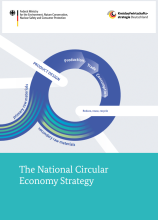
Germany's National Circular Economy Strategy adopts a strategic vision focused on reducing the consumption of primary raw materials. This approach is guided by the proposal from the International Resource Panel, under the United Nations Environment Programme (UNEP), which sets a global target of 6-8 tonnes of raw material consumption per capita per year by 2050.
The strategy considers every stage of the cycle: product design, material selection, production, maximising the use phase and, finally, reuse and recycling. It aims to prevent waste from being created in the first place. This can be achieved through smart product design, efficient manufacturing, extended product lifespans, easier repairability and maximising the recycling of all materials.
Taranto CirTech has launched the Call4Ideas. It invites startups, innovative projects, young companies and emerging organisations to apply to join an acceleration programme designed to transform high-impact ideas into tangible, sustainable and scalable solutions. Apply by 22 June!
FNADE will ask a highly relevant question: how can we make circularity an asset for competitiveness?
The congress will endeavour to identify levers for developing local production of materials and energy from the waste sector in France and Europe. It will also look at ways to reconcile regulatory simplification with the protection of the environment and human health.
This webinar will address the development of social innovation action plans and their deployment and application. Come and gain insights from experts, projects and cities leading systemic change through social innovation!
CirkArena is an R&D centre for the circular economy. Focusing on waste, it aims to help transform the local ecosystem and answer people's questions on the plastics value chain.
Circular Economy Hotspot Slovenia 2025aims to drive on the circular economy and basically make more people familiar with this concept. It will look at the circular economy from the perspective of both the competitiveness and resilience of the EU and Slovenia and the supply and demand system.
On 21-22 May, Tondo will host Re-think Circular Economy Forum Milan 2025: two days of seminars, round tables and networking occasions on the circular economy.
This online event, organised by the Circular Economy Network (C-PRONE), aims to highlight best practices from different countries in overcoming legal fears surrounding circular procurement.
It will also explore how the interpretation of the EU public procurement directive differs across Member States, leading to varying levels of confidence in applying circular criteria.
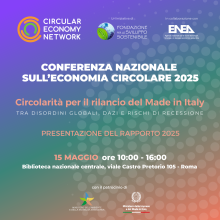
Italy's seventh National Circular Economy Conference will focus on Circularity to Boost Made in Italy.
It will look at how strengthening circular practices can help revive the Made in Italy brand and enhance the competitiveness of key industrial sectors. This is particularly relevant given the ongoing decline in national industrial output which has been exacerbated by recent global instability and trade barriers. The conference will also review the implementation of the Green Deal and recent policy developments at both EU and national levels.