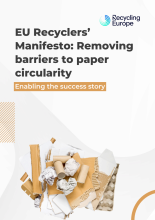
Paper recycling is one of Europe’s greatest circular economy achievements. However, regulatory fragmentation, market imbalances and rising operational risks are placing pressure on recyclers.
Recycling Europe calls on EU policymakers to act. This manifesto proposes four measures to safeguard the success story of paper recycling:
Design circular paper products: recycling should be expected and the CEA should drive demand;
Reduce EU administrative burdens: EU-wide rules on end-of-waste criteria for recovered paper and shipments are needed;
Secure access to global markets for recovered paper: not all recovered paper can be re-used within Europe;
Address the fire risk from lithium batteries in waste management facilities: proper waste sorting is crucial.
This edition of Science for Environment Policy is a collection of seven previously published articles on scientific studies relevant to the circular economy. Read about battery collection, whether laypeople can really understand LCA data, chemical recycling and why people throw away clothing.
This report looks at how scrap steel from the EU's increasing numbers of end-of-life ships can help decarbonise the European steel industry, strengthen industrial resilience, create green jobs, preserve and develop maritime skills and build a truly circular economy.
The steel industry expects demand for scrap to rise due to calls for lower carbon footprints and the implementation of new steelmaking technologies. Ship recycling is a significant and largely untapped opportunity to meet this demand.
Policies should support the development of safe and environmentally sound ship recycling, and stimulate material recovery and reuse. This will enable the EU to reduce dependence on imports, conserve valuable resources and advance toward climate neutrality.
In addition to fruitful discussions, this event will feature a series of interactive workshops fostering dialogue between policymakers, researchers and industry representatives. The three workshops will explore key governance challenges surrounding DPP data management, data models, interoperability and policy compliance, along with DPP policies that affect the economics of green solutions.
The EU SMILE CITY project has come up with Pilot, an off-grid PV panels e-bike charging station made using as many recycled materials as possible. Hear experts from various fields and countries describe the project, the materials and components developed, their performance and their use.
SUINK (SUstainable self-charging power systems developed by INKjet printing) is a Horizon Europe research and innovation project aiming to design and implement sustainable, flexible and printable self-charging power systems to supply power to a wide range of sensors for the automotive industry. See how it's doing this and incorporating circular principles!
SUINK (SUstainable self-charging power systems developed by INKjet printing) is a Horizon Europe research and innovation project aiming to design and implement sustainable, flexible and printable self-charging power systems to supply power to a wide range of sensors for the automotive industry.
This webinar will set out the key results achieved in the development of bio-based conductive, dielectric and piezoelectric inks.
The ECCA has been set up by the European Composites Industry Association (EuCIA) which represents European national composites associations and industry-specific sector groups at EU level.
It was launched in 2025 to establish a circular economy for composites in Europe. It provides a platform for knowledge sharing and cooperation, driving collective action to establish truly circular, sustainable value chains for composite materials. It will set and achieve targets on the use of recovered and recycled composites, develop standards for circular product design and provide a forum for the industry.
Stakeholders across the composites value chain can join the ECCA by signing the declaration. They can then join one of the five working groups, from aerospace to construction to policy/regulation.
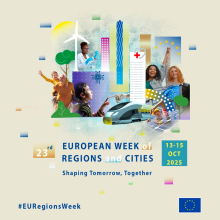
The European Week of Regions and Cities (#EURegionsWeek) is a communication and networking platform fostering cooperation, exchanging knowledge and addressing regional and urban challenges. The motto for this year is Shaping tomorrow, together and some of the sessions and stands are geared to the circular economy.
The European Week of Regions and Cities (#EURegionsWeek) is a communication and networking platform fostering cooperation, exchanging knowledge and addressing regional and urban challenges. The motto for this year is Shaping tomorrow, together and some of the sessions and stands are geared to the circular economy.
Regional Innovation Valleys for Circular Economy will have a stand: come and learn about how the project aims to enhance the policy-making process and build capacities, competence and expertise for professionals related to the circular economy!