The Circular Economy Act is a pivotal opportunity to translate Europe’s ambitions into functioning markets by removing obstacles to the free movement of recycled materials and creating strong demand for circular products.
Recycling is a strategic enabler of circularity and plays a critical role in securing Europe’s economic resilience and decarbonisation agenda. Accordingly, Recycling Europe's policy recommendations aim to unlock demand, establish a level playing field for recycled materials and support the development of a globally competitive recycling industry aligned with the EU’s environmental and strategic objectives.
While welcoming the EU’s recognition of the circular economy’s transformative potential for the EU economy, RREUSE expressed concern about the current narrow focus on recycling and the lack of ambition to promote waste prevention and reuse.
Its recommendations are as follows:
Establish a right to reuse:
Set binding separate targets for (preparing for) reuse;
Set EPR fees in line with the waste hierarchy;
Ensure full cost coverage of (preparing for) reuse activities;
Prioritise reuse in future criteria for circular public procurement.
Unlock the full potential of social circular enterprises:
Guarantee social enterprises’ access to waste streams and collection points, as well as ownership of collected materials;
Allocate earmarked EPR funding for social enterprises;
Academics for Circular Economy welcomes the creation of a Circular Economy Act that aims to address issues such as resource dependence, competitiveness, and environmental pressures. To leverage the full economic, social and environmental potential of the circular economy, the Circular Economy Act must address a number of critical points:
Competitiveness through upstream innovation
European resource independence by design
Resilience of the single market
Environmental protection via a regenerative bioeconomy
The Horizon Europe RECREATE (REcycling technologies for Circular REuse and remanufacturing of fiber-reinforced composite mATErials) project aims to develop a set of innovative technologies which will exploit the potential of end-of-life complex composite waste.
It is organising a webinar looking at practical and emerging approaches for recovering value from end-of-life composite parts.
This collection of businesses in the Region of Murcia which are delivering on circular economy principles is an interactive tool. It is intended to be a source of inspiration and information: users can search for businesses active in specific sectors or focusing on specific circular economy principles.
Businesses across industries increasingly recognise circularity as a strategic lever for resilience, competitiveness and growth. Sourcing rare earths and other critical minerals is also becoming a geopolitical challenge, making the case for circular supply chains.
The conversation has shifted from why circularity matters to how it can be implemented at scale. However, circular strategies are complex to operationalise, so companies require clear priorities, smart design and strong partnerships to overcome scaling challenges.
This white paper outlines methods for prioritisation, approaches to design circular supply chains and key enablers that are essential for scale. It offers leaders actionable strategies to unlock economic value and accelerate circular transformation.
The Circular Venture Blueprint gives Entrepreneurship Support Organisations clear guidance on how to help circular ventures communicate their unique value, measure multidimensional impact or navigate markets built for linear business models.
It provides practical frameworks, tools and methodologies specifically designed for supporting circular economy ventures globally.
The workshop will bring together EU policymakers, researchers and construction stakeholders to explore how innovative materials, digital technologies and reuse strategies can together advance circularity in Europe’s built environment.
It aims to mirror the circular lifecycle of materials, from innovation and data acquisition to reuse and regeneration, and show how circular economy principles can be embedded into the construction sector.
This event will inform policy discussions taking place within several key European Parliament committees and shine a light on the multiple benefits of the bioeconomy for sustainability. It will look at the role and potential of the forest-based bioeconomy which offers renewable and circular solutions for packaging, hygiene, construction, energy and more.
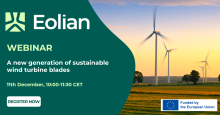
The EU-funded EOLIAN project is developing a new generation of smart, sustainable wind turbine blades. This aligns with the wind energy industry's commitment of enhanced sustainability and reduced environmental impacts over the complete life cycle of a wind turbine. This webinar will present the project's objectives, innovations, and expected outcomes.