While procurement can be an accelerator for circular economy in organisations, scaling up the positive outcomes of successful pilots can be difficult, due to specific internal agreements, culture and values (organisational attitude).
This third training session of the BRINC Network of Public Authorities will provide suggestions and advice on how to change and evolve governance structures (mindset, attitude, culture), to support the implementation of circular economy within your organization.
This International Labour Organization (ILO) report analyses the impact of the transition to low-carbon and resource-efficient economies, providing new insights into likely occupational skill effects in declining and growing industries by 2030 based on the global scenarios of "energy sustainability" and "circular economy". Evidence of good practices collected demonstrates how skills development can underpin the green transition.
This series of webinars - each aimed at a specific target audience and hosted by BUILD UP - will highlight how different stakeholders could join forces to reskill and upskill the building sector workforce with circular skills by highlighting the main takeaways and outcomes of the EU-funded project BUS-GoCircular.
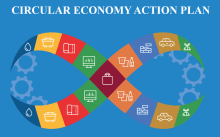
The Romanian Government has approved an Action Plan promoting the Circular Economy as part of the National Strategy for the Circular Economy (NSCE). The action plan sets out a national vision for speeding up the transition to a circular economy, with measures geared to the nine economic sectors with the greatest potential for circularity in Romania's economy: agriculture and forestry; automotive; construction; food and beverages; packaging; textiles; electrical and electronic equipment; waste; water; wastewater.
The action plan has a cross-sectoral strand including promotion activities and a monitoring platform. It also stipulates 52 priority measures scheduled to be rolled out between 2024 and 2032.
This conference (in Romanian) will take place in Cluj-Napoca (Romania) on 3 November (10:30 – 14.00 CET).
It aims to facilitate dialogue and the exchange of best practices at regional level on water and wastewater policy with a view to promoting sustainable water resource management, ensuring universal access to drinking water, public sewerage and wastewater treatment services, and implementing a specific circular economy action.
Registrations are now open for the Circular Cities and Regions Initiative (CCRI) first General Conference “From vision to reality: Cities and regions drive forward Europe's circular transition”, to take place on 8 November in Brussels and online.
About 200 participants will have the chance to attend in person. Learn about opportunities for scaling up circular solutions, exchange ideas with stakeholders and pave the way for Europe's circular transition.
On 9 November, CCRI stakeholders will be invited to attend the second CCRI Coordination and Support Workshop where they will be able to take part in a matchmaking experiment. Register for the Conference today!
Despite growing efforts by political bodies, companies and researchers to support the transition towards a more sustainable and circular economy, we are still behind schedule.
The seminar on 17 October will address the following challenges that are slowing down this transition:
the need for quantitative but easy-to-handle methods to support decision-making in the product design phase, particularly concerning material selection for sustainability,
the potential rebound effects that undercut the expected sustainability gains of moves towards circularity.
As part of London Circular Economy Week, CLG Europe’s Materials and Products Taskforce will be hosting a webinar setting out EU circular economy policy.
Public authorities - policymakers, procurement professionals, local and regional authorities, and other public sector actors - have an important role to play in the transition towards a more circular built environment and have a range of policy levers at their disposal to stimulate demand for circular skills. Using circular strategies in the built environment can help reduce the embodied emissions of building materials by 50%.
This interactive webinar will show how to train staff and how local authorities can work with stakeholders to train the whole value chain to promote circularity.
The webinar will present the guidance for policymakers as well as training materials developed by the BUS-GoCircular project. It will also explain how public authorities can use the Fundamentals Training Packs for SMEs in their requirements in tenders.
It aims to influence policy discussions by enabling progressive businesses across sectors and value chains to join forces. It brings together companies committed to using climate neutral and sustainable materials and which are raising awareness about the need for EU measures to help decarbonise materials.
The key objective is to drive the development and implementation of and support for more ambitious, future-proof policies, programmes and initiatives in Europe with a view to creating an ecosystem moving rapidly away from the energy- and resource-intensive production of materials.