The European Commission is seeking feedback on possible revisions to the criteria of the EU Taxonomy, the classification system for sustainable economic activities. The goal of the revision is to make the framework simpler and easier to use.
DPPSkop is a comprehensive B2B SaaS platform developed to meet the Digital Product Passport (DPP) requirements mandated under the EU’s Ecodesign for Sustainable Products Regulation.
The platform enables manufacturers, particularly in high-impact sectors such as textiles, batteries and electronics, to digitise, manage and share the lifecycle data of their products.
This event will bring together experts, policymakers, researchers and practitioners to discuss how innovation, governance and finance can accelerate the transition toward a circular economy.
The Go Circular Summit brings together stakeholders from across the plastics value chain to review regulatory developments, exchange information on current practices and innovations, and discuss approaches to advancing circularity in Europe.
There will also be a preconference day focusing on textiles recycling!
This conference will present leading solutions and innovations for replacing fossil carbon with biomass, CO₂ utilisation and recycling.
There will be three days of discussions and presentations, focusing on the defossilisation of the chemical industry, fossil-free plastics, and policies, frameworks and regenerative business models.
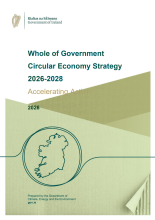
This strategy positions circularity as pivotal for Ireland's economic competitiveness, environmental sustainability and social wellbeing.
It aims to take Ireland from a linear model to a regenerative, closed-loop system where materials are kept in use for as long as possible. Actions and targets for specific sectors (construction, agriculture, retail, packaging, textiles & electronic equipment) are included, with a view to reducing material resource consumption and boosting repair, reuse and re-usable products and materials.
Core objectives:
Raise Ireland’s circular material use rate from 2.7%
Support economic expansion
Enhance competitiveness and innovation
Enhance social equity
Empower people
Actively support local authorities
Establish digitalisation as an enabler of the circular economy
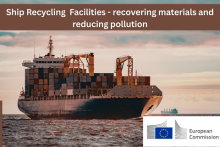
Ship recycling plays a key role in advancing the circular economy - after all, ships do contain large amounts of high-quality steel and other valuable materials.
The European Commission has just adopted the 15th edition of the European List of Ship Recycling Facilities: read about what this means!
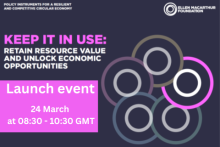
The Ellen MacArthur Foundation is organising two webinars to launch their latest policy brief on Keep it in use: Retain resource value and unlock economic opportunities.
This session will explore key policy instruments, including Extended Producer Responsibility and waste regulations and resource classifications, and how shared understanding and clear frameworks can help keep products, parts and materials in use.
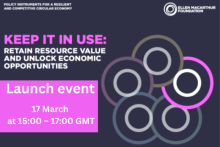
The Ellen MacArthur Foundation is organising two webinars to launch their latest policy brief on Keep it in use: Retain resource value and unlock economic opportunities.
This session will explore key policy instruments, including Extended Producer Responsibility and secondary materials markets, and the role of effective coordination in enabling a policy framework for the circular economy.
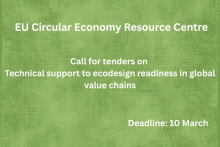
The EU Circular Economy Resource Centre (EU CERC) has published a call for tenders intended to prepare policymakers and the private sector in EU CERC partner countries for the EU Ecodesign for Sustainable Products Regulation. Read all about it!