The Data Centre Industry (DCI) is one of the most important pillars of current technological and economic developments.
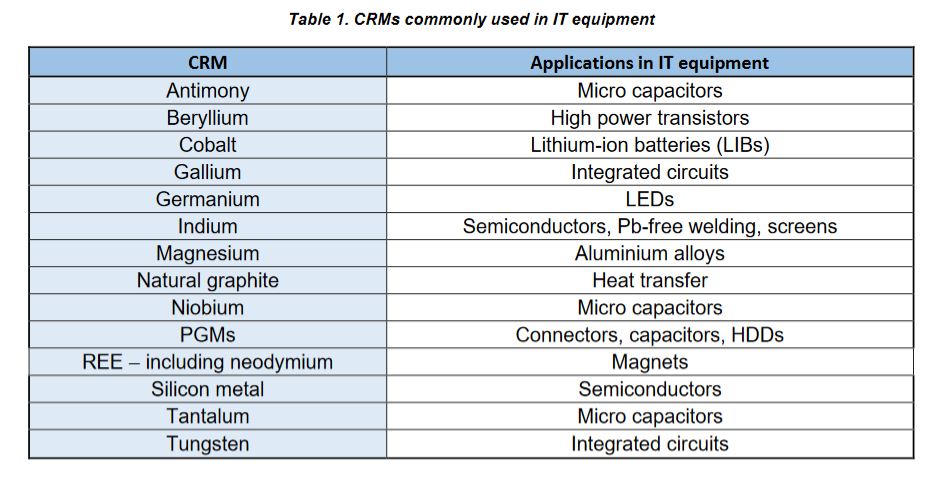
In DCIs, more than fifty different materials can be found per product, including ferrous, non-ferrous metals, precious metals (PM), platinum group metals (PGM), rare earth elements (REE), plastics and/or ceramics, some being considered as Critical Raw Materials (CRMs).
This assessment aims to study DCI design and material composition (specifically servers and switches), as well as to analyse their performance in a circular economy and provide recommendations for ecodesign guidelines.
ENEA, the Italian National Agency for New Technologies, Energy and Sustainable Economic Development, is carrying out research into lithium-sulphur batteries to make them more competitive.
The circular economy project CIRC4Life offers a collaborative way of developing new products, one that integrates consumer needs and where consumers play a central role.
Sika has developed a high-performance elastomer for the clean repair of the rubber substrate of conveyor belts and industrial rubber elements. This "liquid rubber" enables on-site repair and lengthens the product life of used belts.
Following successful 2017 and 2018 editions, both in Krakow, MEERI-PAS and the WRMC organised a 3rd edition of this conference in Racławice from 2 to 3 July 2019 for more than 200 participants.
CECIMO has published a report underlining how the shift towards a circular economy calls for a prominent role of manufacturing. Within it, the machine tool sector plays a crucial role. Machine tools already have multiple lifetimes and embrace some key principles of the circular economy. But there is always room for improvement.
The sector can invest in advanced manufacturing technologies, but also build upon the existing good practices. This would lead to improved productivity and resource efficiency, and consumers enjoying products that last longer and use less energy.
The report also makes recommendations to the industry and policy makers.
When designing the varioPrint 135, Océ (which changed its name to Canon Production Printing in 2019) partnered with the Netherlands Enterprise Agency and Philips to experiment with the use of recycled plastic in the production of industrial printers. The company has made a further step towards circular economy and succeeded in developing an internal component that contains at least 30% post-consumer recycled polycarbonate.