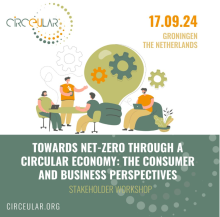
CircEUlar is a four-year European Research and Innovation Action. It began work in September 2022 and seeks to understand the dynamics and levers for transforming society into a net-zero emissions circular economy.
The CircEUlar project team is now organising a workshop where stakeholders will be able to hear about their latest research and contribute to shaping the next phases of work.
ICLEI - Local Governments for Sustainability is a global network of more than 1 750 local and regional governments committed to sustainable urban development. Active in over 100 countries, ICLEI influences sustainability policy and drives local action for low emission, nature-based, equitable, resilient and circular development.
Simon Clement joined ICLEI Europe in 2002. As Head of Circular Economy, he is responsible for ICLEI's activities in this field, including managing the European Circular Cities Declaration. For over 20 years he has worked for, and on behalf of, local, regional and national governments in project, policy and strategy development on sustainability issues such as circular economy, procurement, transport and smart cities.
The European Commission is calling on European cities committed to sustainability to apply for the 2026 European Green Capital and Green Leaf Awards. The call for applications is open until 30 April 2024.
SUSTAINair is a project funded by the EU Horizon 2020 programme. It aims to revolutionise aviation through groundbreaking technologies and impactful solutions.
Circular Aviation in the EU, SUSTAINair’s final conference, will bring together researchers, industry leaders and stakeholders to discuss the future of aviation sustainability. This flagship event will take place in Vienna on 11-12 June.
The transformation into a circular economy entails factoring resource flows into production, sales and consumption processes and thus massively reducing the use of materials (raw or otherwise), as well as the volume of waste and the strain on the environment.
Austria's circular economy strategy therefore aims to:
Circular Week, an international series of events dedicated to sustainable development and the circular economy, will take place this year from 23 to 29 October.
Look through the full agenda of events and sign up!
The conference on Green PLM 2023 - We enable the shift to sustainability will feature presentations and discussions on data management and digital solutions for product carbon footprints, secondary material rates and circularity.
There is a fee to take part in this conference, which will be held in Berlin on 9 November 2023. The event will be partly in German and partly in English.
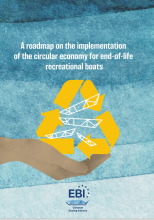
The boating industry in Europe, represented by the European Boating Industry, has developed a roadmap for solving the roadblocks to end-of-life boat recycling. It sets ambitious targets and policy recommendations to reach by 2030. The boating industry also commits to phasing out unsustainable recycling practices.
The roadmap and recommendations were developed by EBI following the work of the Stakeholders’ Group on end-of-life recreational boats. The Group is co-chaired by the European Commission's DG MARE and EBI and includes national authorities of the Member States and key stakeholders (industry, users, academia and related industries).
Kosovo, a potential EU candidate country, has embarked on an ambitious journey – the transition towards a circular economy. The aim of this journey is:
to preserve the country’s nature and rich biodiversity
to valorise its resources and talent,
to contribute to a more resilient and regenerative economy and a society where everyone has the opportunity to live a good life.
This roadmap by Kosovo's Ministry of Environment, Spatial Planning and Infrastructure identifies six priority areas: a) food and b) forestry systems, c) creative and d) retail sectors, e) built environment and the f) manufacturing sector.
Given the strong interdependency of these sectors, the Roadmap also introduces horizontal areas that enable and support priority areas and further promote circular transition.
This paper analyses CE policies and discourses in three European cities to draw critical insights and recommendations.
It first reviews the academic literature on urban CE policies to develop a new conceptual framework for analysing CE discourses and policies. This is then used to analyse and compare the CE policies of Glasgow, Amsterdam and Copenhagen.
Results show that technocentric approaches to the CE are dominant in the three cities. Moreover, they have very limited social justice policies for fair distribution of the costs and benefits of a CE transition. Key policy recommendations to address these shortcomings are thus proposed.
The insights offered by this paper are valuable for practitioners and academics seeking to improve urban CE policies.