EuroCommerce is the principal European organisation representing the retail and wholesale sector. It embraces national associations in 31 countries and 5.4 million companies, both leading global players such as Carrefour, Ikea, Metro and Tesco, and many small businesses. Retail and wholesale provide a link between producers and 500 million European consumers over a billion times a day. It generates 1 in 7 jobs, providing a varied career for 29 million Europeans, many of them young people. It also supports millions of further jobs throughout the supply chain, from small local suppliers to international businesses. EuroCommerce is the recognised European social partner for the retail and wholesale sector.
Nick Dornheim is advisor for Environment & Sustainability at EuroCommerce. He focuses on promoting retailers' and wholesalers' circular economy initiatives such as deploying more sustainable products, ensuring the right waste management infrastructure and empowering consumers.
Curaden Slovakia, the Slovak branch of the Swiss company Curaden AG, collects used toothbrushes for recycling in Slovakia. The company has been encouraging consumers to recycle their end-of-life products since 2017 through public awareness campaigns.
The French company, Envie Autonomie, collects and renovates technical equipment, such as wheelchairs, used beds, walkers and other aids. In this way, they ensure a second life to important equipment.
Upcycling Scandinavia designs practical objects using upcycled materials such as paper, cardboard and pre-use plastic from industry. Its products are reusable and can be looped back into the manufacturing of new products.
The Donar company was established in 1989 in Slovenia, as demand for office interior development was growing. Starting as a small business, Donar has developed into one of the key players in design furniture with the highest environmental standards.
AIMPLAS, the Plastics Technology Centre, is coordinating a project called C-SERVEES to develop more circular products like washing machines, laser printers and toner cartridges, TV sets and telecom equipment.
From a circular point of view, the wide range of products considered to be "furniture" and the diverse use of materials in production (e.g. wood, plastics, textile, steel, glass, composites, foam) makes it a complex area to address.
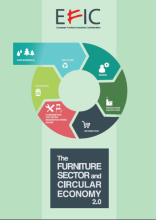
The European Furniture Industries Confederation (EFIC) has drawn up a position paper that identifies challenges and opportunities linked to the circular economy transition, covering the different phases of manufacturing from supply of materials to the end-of-life phase, and that provides sector-specific expertise on EU Circular Economy policies.
Holland Circular Hotspot is a private-public platform in which companies, knowledge institutes and local authorities collaborate to promote and support international collaboration and knowledge exchange on Dutch circular economy, and the Netherlands Enterprise Agency, a government agency for sustainable, agricultural, innovative and international business development and growth, have come together to share insights, networks and resources to help kickstart circular developments that will boost the Sustainable Development Goals (SDGs).
Circular examples from various market segments closely linked to SDGs such as agri-food, manufacturing and the built environment are included in the brochure next to cross-sectoral topics such as consumer goods or plastics.