The brochure highlights Dutch circular frontrunners that make a change - just a fraction of the initiatives, organisations and technologies available. Only the most inspiring examples have been selected, with a potential to be upscaled and implemented in other parts of the world, hoping that they will also inspire and encourage others to collaborate and make a change.
Ms. Bay is a handbag brand that creates products made of rescued waste material and following fair-trade manufacturing ethics. The main material in their collection is salmon-leather. This has qualities similar to regular leather but is processed in a more environmental-friendly way and is highly durable.
The Waste Action Plan for a Circular Economy fulfils the commitment in the Programme for Irish Government to publish and start implementing a new National Waste Action Plan. This new national waste policy will inform and give direction to waste planning and management in Ireland over the coming years. It will be followed later this year by an All of Government Circular Economy Strategy. The need to embed climate action in all strands of public policy aligns with the goals of the European Green Deal.
The policy document contains over 200 measures across various waste areas including Circular Economy, Municipal Waste, Consumer Protection and Citizen Engagement, Plastics and Packaging, Construction and Demolition, Textiles, Green Public Procurement and Waste Enforcement.
The Sustainable products initiative, which will revise the Ecodesign Directive and propose additional legislative measures as appropriate, aims to make products placed on the EU market more sustainable. You are welcome to give your feedback on it until 2 November 2020.
Cork-A-Tex is a project that uses recycled cork to create a yarn with high incorporation of cork. Cork is a 100% natural material made from the oak cork trees which can be recycled after its use as cork stopper in wine bottles.
A new project addressing the systemic complexities of the Circular Economy is being submitted as a Marie Curie (MSCA) post doc proposal. As these aspects build upon multi-stakeholder knowledge and insights, you are kindly invited to join the project community and collaborate.
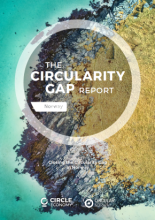
The Circularity Gap Report Norway is an in-depth analysis of how Norway consumes raw materials to fuel its societal needs. Currently, 97.6% of materials consumed each year never make it back into the economy.
Norway also has one of the highest per capita consumption rates in the world (44.3 tonnes per person). At 2.4%, its circularity rate is below the global average (8.6%). Each year Norway consumes 235 million tonnes of materials - metals, fossil fuels, biomass and minerals - to meet its internal needs.
However, the report reveals how Norway could see a 20-fold increase in its circularity by restructuring its businesses and industry through 6 key actions in the following fields:
This case study on the EU's Circular Economy Plan (CEAP) by the Ellen McArthur Foundation reflects back on the steps which the European Commission took to take a lead in circular economy policies globally. From initially aiming at improving resource efficiency, to redefining growth with positive social, environmental, and economic benefits, this case study analyses this policy-making process.
The CEAP was a comprehensive body of legislative and non-legislative actions adopted in 2015, which aimed to transition the European economy from a linear to a circular model. It mapped out 54 actions, as well as four legislative proposals on waste.
By rethinking resource efficiency and material flows, the European Commission has developed a framework to promote systemic change.
The Coordination Group decided, in autumn 2019, to create focus groups to hold in-depth discuss and deliver orientations on priority topics.
Textiles are a vast category. The ECESP leadership group on textile focused on the TGLF value chain. Their discussion focused on ways to address essential challenges from a social, environmental and economic perspective.
In 2019 the European Commission set out a policy guideline to address global environmental challenges and circularity. EURATEXand its members welcome the ambition of the EU Institutions to change the old way and commit to engage with all relevant parties to deliver and implement a new Textile Strategy to boost the circular economy and be fit for the present and future generations.
This strategy by EURATEX is a starting point, with insights into solutions based on a 14-month consultation with members, involving over 100 companies and key stakeholders, focused on applied circular practices and future opportunities. It prioritises removing barriers to a large-scale uptake of circular economy in textiles, sets out 12 key points and puts forward 38 proposals.