This online workshop on 23 April will focus on the certification scheme for the implementation and monitoring of the waste management system using cold chain traceability and PAYT (Pay-As-You-Throw) schemes.
It is organised by the University of Copenhagen as part of the FOODRUS project, which aims to prevent food loss and waste and promote resource efficiency across the agri-food value chain.
Ms Ettinger is a lawyer in Germany and holds a Master of Law degree from George Mason University (USA). Before joining EuRIC, she worked at a Brussels-based consultancy, advising multinational companies on environmental, health and safety matters.
EuRIC is a confederation which represents the interests of European recycling industries within the EU. It spans the majority of waste streams, and so can facilitate cooperation between national recycling and resource management federations and companies from over 23 European countries, operating both locally and globally.
EuRIC represents:
5 500+ companies generating an aggregated annual turnover of about €95 billion, including large companies and SMEs involved in the recycling of and trade in various resource streams
300 000 local jobs which cannot be outsourced to non-EU countries
a million tons of waste recycled each year (metals, paper, glass, plastics, WEEE, ELVs, tyres, textiles, construction & demolition, etc.).
By turning waste into resources, recycling loops recycled materials back into value chains. Recyclers play a key role in bridging resource efficiency, climate change policy and the industrial transition.
The 2024 edition of the Global Resources Outlook, from the International Resource Panel, shows that it is both possible and profitable to decouple economic growth from environmental impacts and resource use. It sheds light on how resources are essential to the effective implementation of the Agenda 2030 and multilateral environmental agreements to tackle the triple planetary crisis.
It is to be noted that the circular models to be followed are not just about recycling, but about keeping materials in use for as long as possible, and rethinking how goods as well as services are designed and delivered, thereby creating new business models.
The report also describes the potential to turn negative trends around and put humanity on a trajectory towards sustainability.
A modern society needs access to all the critical raw materials (CRM) necessary to maintain and develop its industries, infrastructure and welfare. CRM are especially important for ongoing technology shifts like the European Green Deal and digitalisation processes.
Five milestones must be reached to establish Nordic secondary value chains for CRM:
A system that makes it possible to identify waste streams with CRM-recycling potential.
A system for cost-effective and efficient collection of waste streams with CRM-recycling potential.
A system for separating materials enriched with CRM from other materials in the waste stream.
A recycling technology that allows for recovery of all relevant CRM at acceptable rates.
This briefing looks into how circular economy and waste sector policies and measures can reduce greenhouse gas emissions.
It analyses how European countries include circular economy and waste actions in their reporting on climate change mitigation policies and measures and how the introduction of additional measures can help accelerate future reductions of GHG emissions.
The briefing finds that waste management and the circular economy have considerable potential for mitigating climate change. Therefore, countries would benefit from including policies and measures in these areas in their climate policy mix.
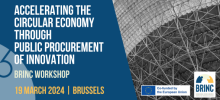
The BRINC(Brokering cross-border Innovation through Clusters) project is holding a workshop where participants will be able to meet the BRINC network of public authorities and other key actors working on public procurement of innovation and circular economy in order to exchange insights and learn from each other.
Biorefine Cluster Europe (BCE) links up projects and people in the area of bio-based resource recovery, with a view to contributing to more sustainable and circular resource management.
It focuses on the biorefinery sector, i.e. chemicals, materials, energy and products from bio-based waste streams:
Bio-based (waste) streams as an input for the circular economy
Bioprocesses
Sustainable bio-energy production in its various shapes, and
Resource recovery: extracting minerals, chemicals, water and materials from biomass.
Its main objectives:
Strengthening interaction between projects
Fostering dissemination and stakeholder outreach
Enhancing research
Identifying gaps in knowledge.
BCE aims to build its community and promote knowledge exchange.
On 29 February at 13:00 – 14:30 CET, the Nordic Working Group for Circular Economy will hold a webinar to present the report on 'Recycling of Critical Raw Materials in the Nordics'.
The report provides a comprehensive overview of the Nordic region's secondary value chains for CRMs.
The GO-GRASS final event will be a chance to discuss the project's final results and the implications for grass-based businesses in a future bio-based economy. It will feature a session on circular business models and technologies developed by the project, two policy panels with high-level representatives from EU, national and local level stakeholders and an excursion to a grass-based paper production facility in the Netherlands.