The European Commission is seeking stakeholder input on how to make EU environmental laws faster, easier and cheaper to implement, thereby making life easier for EU businesses. Is this something you feel strongly about? Then tell them!
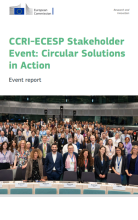
On 5 June, the Circular Cities and Regions Initiative (CCRI) and the European Circular Economy Stakeholder Platform (ECESP) joined forces to host a stakeholder event in Brussels and online as part of EU Green Week 2025. Have a look at CCRI's report on what was said during this event!
Shifting to a circular economy, which is nature-positive by design, can build prosperity while tackling climate change and other global challenges. This study shows that a targeted set of investable and scalable actions in the built environment sector represents a significant economic opportunity for Europe, increasing resilience, competitiveness and the vibrancy of its cities. It also aims to show that circular and nature-positive strategies can be applied across sectors.
To illustrate how the benefits of a nature-positive, circular economy can be realised in a tangible, high-impact way, this study focuses on the built environment using new analysis drawn from quantitative modelling and interviews with expert practitioners.
Over the past decade, the EU has demonstrated an unprecedented commitment to advancing a circular economy, advocating for action at national, regional and local level. However, most economies remain predominantly linear.
This report provides a comprehensive analysis of circular economy practices, challenges and opportunities in cities and regions, building on a survey of 64 cities and regions of the EU, lessons learned from 10 place-based policy dialogues in specific cities and regions, and desk research. It concludes with policy recommendations to accelerate a territorial approach to the circular economy for place-based policies that are aligned with EU-wide goals.
SOPHIA is an EU-funded Horizon Europe project that aims to implement advanced digital solutions in end-of-life solar panels, involving the full value chain in order to increase their current reuse, repair and recycling rates. The end goal is to foster a more circular, innovative and competitive Europe.
This conference will focus on future-proofing clean energy, end-of-life assets, circular energy markets, and advanced technologies and successful business models.
Join top asset owners, recyclers, manufacturers and investors at the second Recycling Renewables Summit and help shape the future of circular renewables.
While circular economy practices offer substantial environmental and economic benefits along with local job creation, their implementation requires significant adjustments in working conditions and practices.
This briefing dives into two of the circular building pathways identified as having high social impacts in the Circular Buildings Coalition’s 2024 Four Pathways Report: 1) Build with the Right Materials; and 2) Build Nothing.
These pathways are explored, along with their regulatory and market-level drivers, barriers and the measures needed to safeguard workers.
STICA Climate Action Week 2025 took place just last month - and the interviews with various stakeholders which were released during it are now available. From the impact of climate change on workers to circular textiles made from waste, you're sure to find some in line with your area of interest!
UtilDeco Group SRL has become Romania’s flagship work-integration social enterprise.
In 2023, it linked its textiles and coffee operations in a circular-economy pilot scheme: fabric off-cuts from uniform production and empty jute coffee sacks were upcycled into OPYA Fashion, a limited-edition collection of jackets, totes and accessories.
The enterprise is now scaling circularity through two major projects, one on digital product passports in textile products and the other on hiring workwear.
The WEEE Forum aimed to formulate recommendations on potential future targets for WEEE collection and on the method for calculating the collection rate which would foster the circular economy.
This study accordingly conducted a comprehensive assessment of current WEEE collection rate calculation methodologies and proposes a new approach for setting WEEE collection targets in the EU. It took a multi-phase approach, including data collection, model development and sensitivity analysis. Interviews with experts and stakeholders were also carried out to validate assumptions and explore new target-setting approaches.
The study concludes that the WEEE generated method is preferable to the current POM (put on the market)-based collection target.