This event will present practical experiences with circular procurement criteria, market consultations and capacity building.
It will also discuss challenges such as the tendency to prioritise short-term benefits over long-term value and the perception that markets and organisations are not yet ready for circular solutions.
The Global Bioeconomy Summit 2026 will bring together leaders from policy, science, industry and civil society to explore how the bioeconomy can be scaled as a force for change.
It will highlight how bio-based solutions address pressing global crises, from food and energy security to health, biodiversity loss and climate resilience.
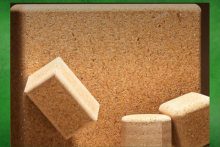
Rice Tab is a technical board developed from rice husks, an agricultural byproduct widely available in Europe.
Designed for applications in architecture, interior design and furniture, it transforms what was once considered waste into a high-performance material with a new functional life in the built environment.
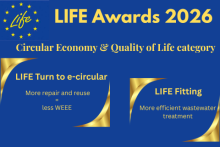
The LIFE Awards 2026 included the Circular Economy & Quality of Life category.
The winner proposed a replicable way to reduce the amount of WEEE generated, and one of the runners up designed tools to optimise wastewater treatment while reducing waster consumption.
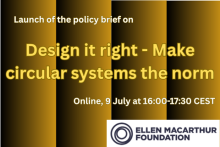
The Ellen MacArthur Foundation is organising a webinar to launch their latest policy brief: Design it right: Make circular systems the norm.
This session will explore key policy instruments, including product, agricultural and urban planning policies, and explore implementation across diverse country contexts, drawing from experiences from the food and plastics packaging systems.
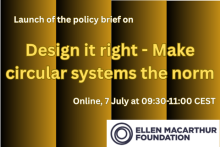
The Ellen MacArthur Foundation is organising a webinar to launch their latest policy brief: Design it right: Make circular systems the norm.
The session will explore key policy instruments, including product, agricultural and urban planning policies, and explore what it takes to make upstream design-led policy work in practice.
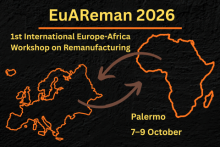
EuAReman 2026 is a Europe-Africa platform dedicated to remanufacturing, circular economy, industrial sustainability, advanced technologies, capacity building and new business models.
It aims to bring together researchers, companies, policy-oriented stakeholders, innovation actors and practitioners from Europe and Africa, with a view to strengthening dialogue and collaboration around remanufacturing as a pillar of the circular economy.
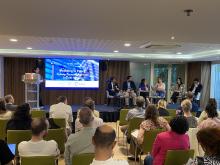
On 28 May, CircEUlar, CIRCOMOD and CO2NSTRUCT held their joint final event.
It was pointed out that material recovery and recycling are not enough: sufficiency measures, service-focused solutions, lifetime extension, digitalisation and behavioural change will all help Europe move further and faster towards net-zero. Read about what else was discussed!