The International Seminar on Plastic Characterisation took place on 29 and 30 October, hosted by AIMPLAS, the Plastics Technology Centre. About a hundred international specialists discussed the latest analytical techniques applied to plastic characterisation, environmental degradation and the challenges of the circular economy. See what was discussed!
CityLoops (Closing the loop for urban material flows) was a Horizon 2020 project which focused on circular economy solutions for bio-waste and construction and demolition waste (CDW). Seven European cities implemented ten demonstration actions and tested over 30 new tools and processes, which are available together with replication packages and feedback from the cities which tested them.
The Advanced Recycling Conference will explore all available recycling technologies for various waste streams, as well as considering policy topics and environmental impacts.
It will bring together technology providers, related industries, waste management companies, brands and investors as well as policy makers and scientists active in the field of recycling and provide a framework for new partnerships, ideas, approaches and value chains.
The ECCA has been set up by the European Composites Industry Association to provide a platform for knowledge sharing and cooperation, driving collective action to establish truly circular, sustainable value chains for composite materials.
In a changing political landscape, the implementation of circular economy strategies presents significant potential for reducing greenhouse gas emissions, decreasing fossil fuel use and altering trade dynamics. Circular economy strategies related to material reduction, reuse and recovery complement industrial decarbonisation measures and have the potential to double GHG savings by 2050.
Through a multi-method analysis, this study shows that an ambitious circular economy scenario can yield substantial annual GHG savings across selected energy-intensive sectors and decrease EU imports, reducing trade dependency and increasing the trade balance by over EUR 30 billion compared to the decarbonised baseline.
This workshop will explore how sustainable urban development can unite environmental responsibility, economic resilience and social well-being, transforming cities into ecosystems that regenerate rather than deplete.
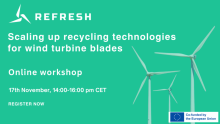
The EU-funded REFRESH project is organising a webinar to present its progress in developing innovative technologies for recycling end-of-service wind turbine blades.
The Nordic Circular Summit is the largest annual conference on circular economy in the Nordics, a gathering point for changemakers, policymakers, researchers and businesses driving the transition to a regenerative circular economy.
This year's summit will focus on Circular frontiers: Shaping our future - From remote realities to global blueprints: How Arctic & Nordic communities can shape the next wave of circular innovation.
This report addresses the question of whether Flanders, with its limited space, will be able to produce enough biomass in the future to supply the bioeconomy and continue to feed the increasing population.
Four scenarios were used, providing insight into the demand development for biobased raw materials for feed, food, fuel and fibre.
It found that:
An open economy, with international imports/exports of bio-based raw materials, is crucial for a small, densely populated and prosperous region like Flanders.
Long-term collaboration with other regions and countries is a strategic necessity. The energy transition, protein shift and circular transition must be streamlined to run synergistically. This can reduce the pressure on raw bio-materials.