Electronics Goes Green 2024 is a conference geared to the growing global community of scientists, product developers, business managers and policymakers working on environmentally benign processes, products, systems and business models in and for the electronics and ICT industry.
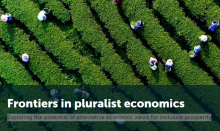
During this event in Rotterdam on 10 June, guest speakers Brian Fath, Michael Roos, Katy Gillespie and Şerban Scrieciu will introduce the audience to alternative economic theories, and how these can play a pivotal role in addressing the complex challenges of the Anthropocene era.
This free event is organised by the Erasmus University Rotterdam initiative Dynamics of Inclusive Prosperity, in collaboration with the Interdisciplinary Climate Economics for Nature and Society - ICENS lab.
The circular economy is a powerful tool which cities and towns can use to tackle climate change, reduce CO2 emissions and regenerate nature. Join this online WCEF accelerator session on 17 April to learn how European cities are harnessing circular practices to achieve climate goals and nature restoration in urban settings.
This all-day event in Brussels on 17 April will feature four expert-led sessions, each focusing on different aspects of how circular economy principles can ensure that the built environment remains within planetary boundaries.
The sessions will explore regenerative design, business cases, circular scenarios and blueprints for solutions.
Circular Computing’s Sustainable IT Summit will take place on 23 April in the United Arab Emirates. It aims to welcome the leaders of some of the largest companies in IT and will combine theory and practice to identify tangible and workable solutions including circular processes such as remanufacturing.
In 2022 the Podravje region (Slovenia) became part of the Circular Cities and Regions Initiative (CCRI) and was selected as one of the 12 CCRI pilots being supported for the implementation of Circular Systemic Solutions (CSS) which could provide answers to major challenges beyond resource management and waste/water recovery.
The region is now developing a circular bioeconomy strategy which is the key document describing the available regional resources and linking them to suitable CSSs.
So far, two rounds of consultations with regional stakeholders have been organised and 9 key CCSs have been identified as the key activities within 4 priority areas:
Linked to the BATRAW project that develops circular approaches for electric vehicle batteries, this CEPS report delves into the new EU regulatory framework for batteries and the expanding EU digital product passport landscape. It identifies key opportunities and challenges for battery passports based on data collected from companies at different stages of the battery value chain.
The data suggest that the battery passport can help break down information silos among supply chain actors and support recycling and reuse. It also provides opportunities for increasing transparency about carbon footprint impacts across battery supply chains, while creating a level playing field with horizontal requirements for all supply chain actors.
The 2024 edition of the Global Resources Outlook, from the International Resource Panel, shows that it is both possible and profitable to decouple economic growth from environmental impacts and resource use. It sheds light on how resources are essential to the effective implementation of the Agenda 2030 and multilateral environmental agreements to tackle the triple planetary crisis.
It is to be noted that the circular models to be followed are not just about recycling, but about keeping materials in use for as long as possible, and rethinking how goods as well as services are designed and delivered, thereby creating new business models.
The report also describes the potential to turn negative trends around and put humanity on a trajectory towards sustainability.
A modern society needs access to all the critical raw materials (CRM) necessary to maintain and develop its industries, infrastructure and welfare. CRM are especially important for ongoing technology shifts like the European Green Deal and digitalisation processes.
Five milestones must be reached to establish Nordic secondary value chains for CRM:
A system that makes it possible to identify waste streams with CRM-recycling potential.
A system for cost-effective and efficient collection of waste streams with CRM-recycling potential.
A system for separating materials enriched with CRM from other materials in the waste stream.
A recycling technology that allows for recovery of all relevant CRM at acceptable rates.