WaVa - Co-products Marketplace is a chemical exchange platform where professionals can sell their manufacturing co-products or buy raw materials. It matches up supply and demand.
Any industrial raw material, waste, by-product or manufacturing co-product can be traded on the WaVa platform, but its chief focus is managing and processing chemical by-products. It aims to help people achieve their circular economy objectives and thus reap the economic and environmental benefits.
WaVa is not recognised as a waste disposal facility; it simply connects buyers and sellers. It never actually takes ownership of the product.
Ireland is at a turning point for the transition to a circular economy (CE). The 2022 Whole of Government Circular Economy Strategy provides the policy framework for the CE in this country, and the forthcoming Circular Economy Bill is expected to strengthen waste and CE legislation.
Nevertheless, with a circularity material use rate of 2% in 2020, Ireland shows significant scope for progress. This report analyses the state of play and challenges of the circular transition in Ireland and provides policy recommendations for CE policy across levels of government. It is the result of a two-year policy dialogue between the OECD, the Department of the Environment, Climate and Communications, as well as a broad range of public, private and civil society stakeholders.
Russia is among the larger suppliers of raw materials to the EU. It is the biggest world supplier for palladium, platinum and nickel, and a prominent one for aluminium and copper. The country still holds large untapped reserves of rare-earth elements.
This paper provides an overview of EU import dependency on raw materials and Russia’s share among EU sources of key supplies for low-carbon technologies. It then looks at prospects for meeting future material demands through circularity for three technologies, namely lithium-ion batteries, wind turbines and fuel cell electric vehicles.
The analysis is based on two scenarios with different levels of ambition. They aim to give an indication of the scale of potential benefits that can be achieved through circular approaches.
This research project lists ecodesign criteria for circular fashion and textiles.
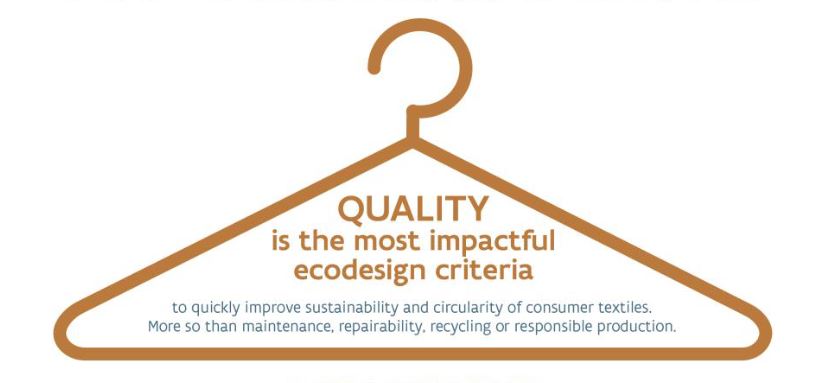
It focused on giving consumer textiles a longer lifespan with optimal reuse potential, making disassembly and recovery possible, and exploring upcycling and high-quality recycling. Extending the life of textile products turned out to have the greatest impact in the short term. Quality seems to be the most impactful ecodesign criterion when it comes to improving the sustainability and circularity of consumer textiles as quickly as possible.
The project defined seven product categories, identifying a set of minimum criteria for each. The report looks at existing labels, standards and regulations and the authors hope it will help expand the Ecodesign Directive by adding a textile category.
Urban agriculture comes with its own share of environmental impacts. Circular strategies promise to reduce these impacts, but not all strategies are resource efficient and environmentally effective.
This paper finds that the most eco-friendly and circular strategies for urban agriculture, taking a Mediterranean tomato crop as a case study, include:
Struvite (phosphate mineral recovered from wastewater treatment) instead of non-renewable phosphate fertiliser to conserve freshwater
Recycled steel and materials for urban agricultural infrastructure to reduce carbon emissions, toxicity and freshwater pollution
Closed-loop irrigation to minimise ocean and freshwater pollution. However, if new infrastructure is required, it could lead to an increase in carbon emissions.
This literature review identified and categorised circular economy (CE) practices within all stages of the food and feed production chain in Europe to provide an overview of current and envisaged practices. There are four macro areas:
reducing food and feed waste in wholesale, food retail, catering and households and
reducing food and feed packaging waste.
It is recommended that future primary research in novel food and feed in the CE focuses on areas other than insect farming, and that there are further investigations into the potential risks associated with importation into the EU of livestock/goods that may have been subject to different restrictions/legislation.
Under the framework of the INSIGHT project, a Blueprint has been developed to provide specific recommendations on how to promote the application of Industrial Symbiosis and its facilitation to various stakeholders, as well as a roadmap of how the organisations are expected to apply the IS principles, by making use of educational specific inputs and resources.