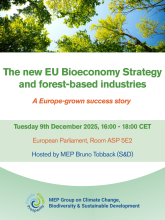
This event will inform policy discussions taking place within several key European Parliament committees and shine a light on the multiple benefits of the bioeconomy for sustainability. It will look at the role and potential of the forest-based bioeconomy which offers renewable and circular solutions for packaging, hygiene, construction, energy and more.
This event will focus on identifying and advancing circular solutions that can be applied across diverse sectors of the national economy, while also addressing the needs and opportunities at the local community level.
ReSBE 2026 aims to redefine how the built environment is designed, constructed, operated and renewed. It will bring together researchers, practitioners, innovators and policymakers to explore transformative solutions for a regenerative future.
Participants will gain insights across circular design and construction, digitalisation and innovation, lifecycle assessment and metrics, climate adaptation and resilience, policy and governance, market transformation, and society and education.
This webinar will explore the revised EU Waste Framework Directive and its implications for the fashion and textile sector, with a particular focus on SMEs. It will focus on the introduction of Extended Producer Responsibility (EPR) for textiles, a major regulatory shift that will place new obligations on producers, retailers and importers related to product lifecycle management, waste and circularity.
The German Federal Environment Ministry invites you to the first annual conference on the implementation of the National Circular Economy Strategy. Under the leadership of the Federal Environment Ministry, the German government is continuing to take the next important step towards a comprehensive circular economy.
This session will launch RREUSE's report on targets for reuse and preparing for reuse in the European Union. It will delve into the report’s key findings and explore how ambitious, measurable reuse targets can accelerate Europe’s circular economy transition.
Tech4Biowaste (A DYNAMIC DATABASE OF RELEVANT TECHNOLOGIES OF BIO-WASTE UTILISATION) was an EU-funded project which created a database providing a comprehensive technology overview for the valorisation of bio-waste. Businesses can promote their technologies and stakeholders can search for the most appropriate technology for their particular feedstock.
Cradle to Cradle Certified® is a globally recognised standard used across industries by designers, brands and manufacturers to verify leadership in circular design and material health. It provides the framework for assessing the circularity and sustainability performance of materials and products across five categories, including product circularity.
CityLoops (Closing the loop for urban material flows) was a Horizon 2020 project which focused on circular economy solutions for bio-waste and construction and demolition waste (CDW). Seven European cities implemented ten demonstration actions and tested over 30 new tools and processes, which are available together with replication packages and feedback from the cities which tested them.
The COLLECTORS project (waste COLLECTiOn systems assessed and good pRacticeS identified) identified good practices in waste collection and sorting, focusing on paper and packaging, waste electrical and electronic equipment, and construction and demolition.