The Joint Research Centre (JRC) of the European Commission has just published a report on construction & demolition waste (CDW) which confirms that the circular economy is crucial for reaching climate neutrality by 2050:
- construction & demolition waste accounts for almost 40% of all waste generated in the EU - the new JRC study estimates the potential for recycling and preparing for re-use of CDW to be roughly 83% - realising this potential would lead to an additional 33 Mt CO2e savings annually (equivalent to the combined annual emissions of e.g. Estonia, Latvia and Luxembourg).
The European Commission is taking important legislative and non-legislative steps to ensure CDW is managed in an environmentally sound manner and contributes to the circular economy.
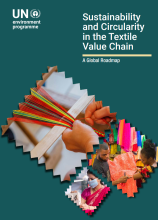
This UNEP report outlines what each stakeholder group can do individually and collectively to reach the shared destination of a circular textile sector.
The Foundation aims to accelerate the transition to the circular economy, drawing on an international team of experts based in Amsterdam who flag up practical and scalable solutions to put the circular economy into action. The ultimate goal is to see global circularity double by 2032.
The Impact Report focuses on the Circularity Gap Reporting Initiative, thanks to which Circle Economy Foundation - over the years - has tracked global circularity and highlighted replicable case studies in its Circularity Gap Reports covering countries from Austria to Latin America and the Caribbean. The Initiative continues to bring together global, multi-sector stakeholders from academia, business, government and the
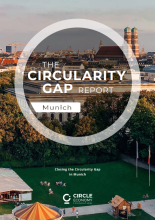
The Circularity Gap Report Munich is the first study measuring the Circularity Gap of a city. It assesses the city’s material consumption, material cycling, consumption-based carbon footprint and other indicators. It uses a consumption-based carbon accounting approach for emissions from goods and services consumed by residents of a locality. On average, each Munich resident consumes 32 tonnes of virgin materials annually.
The study acknowledges the successes of Munich’s circular economy strategy with initiatives like investment in public transport, community gardens and remanufacturing activities, but calls for bolder action to accelerate the circular transition
This catalogue aims to provide waste management experts and decision makers in the Mediterranean region with an overview of successful practices, solutions and approaches in waste separation, collection, treatment and recycling in the Mediterranean.
It examines five projects spanning this region and covering issues such as employing a circular economy approach for the organic fraction of municipal solid waste management. It also highlights the lessons that should be considered when replicating successes and avoiding pitfalls.
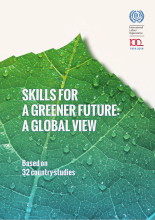
This International Labour Organization (ILO) report analyses the impact of the transition to low-carbon and resource-efficient economies, providing new insights into likely occupational skill effects in declining and growing industries by 2030 based on the global scenarios of "energy sustainability" and "circular economy". Evidence of good practices collected demonstrates how skills development can underpin the green transition.
This International Labour Organization (ILO) report examines environmental sustainability in the world of work.
It focuses on how climate change and environmental degradation will have an impact on labour markets by affecting the volume and quality of employment, and quantifies the shifts expected to take place within and between sectors. It also models employment shifts by region and sector under a circular economy scenario.
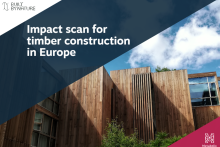
At European level, the built environment is responsible for 40% of CO2-eq emissions and roughly 60% of material consumption.
By applying bio-based alternatives to conventional ‘mineral’ construction materials, the environmental impact of the EU27+UK sector can be reduced by 18%.
However, there is a limit to the sustainable wood supply that can be harvested without compromising vital functions provided by forests, and the projected increase in wood consumption is not compatible with the realistic growth potential of harvesting activities. Therefore resource efficiency, bio-based added value or demand for new housing should be carefully weighted in to ensure a sustainable shift, the study concludes.
Denmark is already excelling in many areas of sustainability, positioning itself as an ambitious frontrunner in the race to net-zero. It already boasts mostly renewable electricity generation, with targets to achieve 100% green electricity by 2027 and entirely renewable energy by 2050.
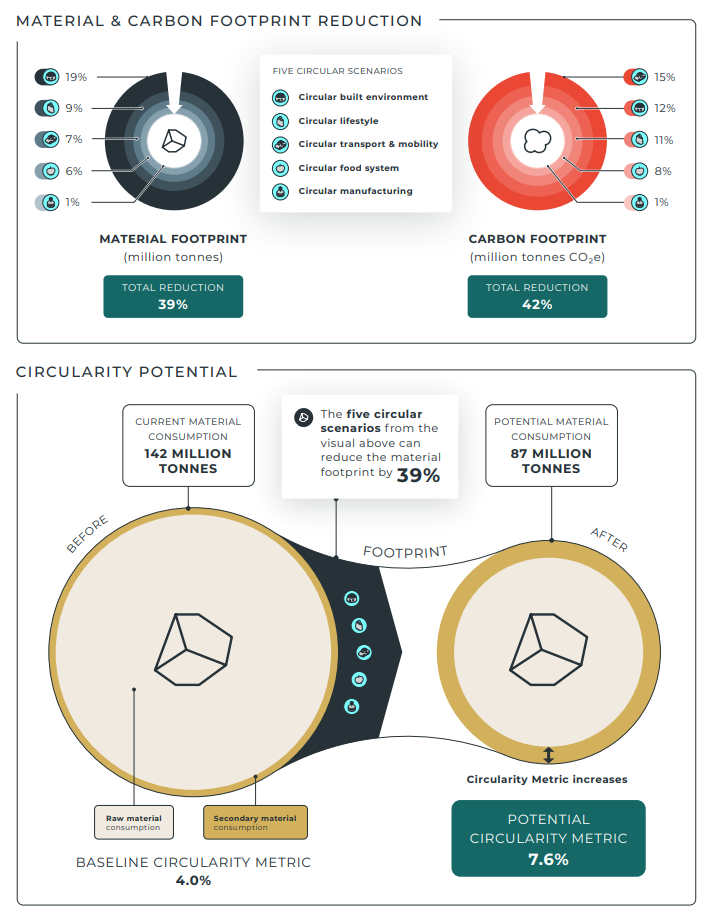
The Circularity Gap Report on Denmark reveals that the country’s economy is 4% circular. This figure is defined by very high material consumption - 24.5 tonnes of virgin materials per person per year. This puts the country above both the European average of 17.8 tonnes per capita and the global average of 11.9 tonnes per capita.
The report also lays out five circular pathways for Denmark that have the potential to cut its material and carbon footprints by roughly 40% each.
Europe and the world face unprecedented sustainability challenges, largely as a result of unsustainable consumption. Since similar consumption patterns are expected to continue, technological and efficiency gains are likely to be insufficient to keep environmental and climate pressures within sustainable limits.
A more circular economy in Europe has the potential to reduce environmental and climate pressures and impacts from our consumption, but will require reshaping our consumption and production systems. This report presents trends in European household consumption and its environmental and climate pressures, and explores conditions for and pathways to a transition towards more sustainable and circular consumption patterns in Europe.