This short-term assignment attempts to improve our understanding of the data availability of biomass flows within the Flemish economy and develops a methodology to approximate the flow of biomass between different industries.
This needs to be done in order to maximise their potential and reduce unnecessary waste flows. However, the report finds that the data currently available are insufficient, and considers that the construction of a physical counterpart to monetary input/output tables might be the answer.
The production of Portland cement (PC) is responsible for 8-10 % of the global anthropogenic CO2 emissions. PC and PC-based blends are the most common binder in concrete production (< 99 % of cases). As PC is accountable for 74-81% of the CO2 footprint, substantial climate impact reductions for concrete requires eco-innovation at the cement level.
One of the most promising technologies to lower CO2 emissions consists in partially replacing traditional PC with industrial byproducts displaying cementitious properties, such as blast furnace slag from iron production, or coal combustion fly ashes from power generation, but their availability and properties are rather constrained.
A diversification of local (secondary) raw materials to extend partial substitution of PC is ongoing.
This study highlights that, while international trade has a vital role to play, policy responses to-date have largely been designed at the national level and in an uncoordinated manner.
ICC Secretary General John W.H. Denton says that "the report shines a light on how well-intentioned national policies are inadvertently hindering the adoption of circular solutions in the real-economy. Simply put: the transition to a circular economy can only be enabled at scale by harnessing the power of cross-border trade to unlock economies of scale and comparative advantages. We hope our analysis will serve as a clarion call for a concerted global effort under the auspices of the World Trade Organization to enable new patterns of trade capable of meeting global climate and sustainability goals".
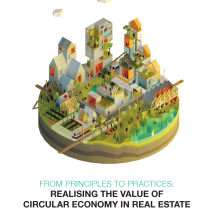
Arup has joined forces with the Ellen MacArthur Foundation to produce a report on the value of circular economyin real estate.
The circular economy offers real estate investors a framework for achieving environmental and social goals while delivering better economic performance. How do real estate business models need to change - apart from eco-design - if circular principles are to scale up in this sector?
The report defines five models to improve financial performance to the benefit of real estate investors and construction clients:
In many countries, the government is the single largest purchaser of products, services and works. Green Public Procurement (GPP) enables governments to reduce the environmental impact of their purchases. It also serves as a powerful tool for governments to simultaneously achieve their environmental and development policy objectives.
This report provides an overview of international experience in the implementation of GPP. It focuses on the institutional framework that is needed to support the mainstreaming of GPP practices across governments. The intention is to equip practitioners with a broad understanding of the issues they need to consider in the design and implementation of GPP reforms.
The benefits of transitioning to a circular economy outweigh the disadvantages. However, more efforts are needed to move from conceptualisation to implementation. The transition requires a political commitment and the right business mindset. It also requires prioritisation and investment in innovation, the utilisation of new technological solutions, and the right set of skills and competences.
So far, there has been very limited focus on what skills and competences are needed for this transition and whether Nordic STEM education provides them. This report introduces the basis for a Circular Economy Competence Framework for STEM specialists, including a set of essential technical and analytical skills for creating circular solutions.
Circular Threads aims to paint a picture of sustainability and circularity practices in the fashion and textile industry in Northern Italy.
This study is a starting point for fostering the transition towards circular production models in the Italian textile industry. Researchers have developed a tripartite approach (desk research, questionnaire and circularity assessment) with different levels of granularity to measure the sustainability and circularity of the companies present in this area.
The report highlights how few companies in the fashion and textile industry are adopting circular practices and strategies, and a clear lack of knowledge sharing about the potential opportunities that the circular economy can offer businesses on a systemic level.
The French National Institute for Circular Economy (INEC) has published this paper which aims to use schools - a place familiar to all - as showcases for the circular economy. It contains a series of good practices (for public and private actors, youth) comprising over 40 territorial initiatives and 50 operational solutions, on the following themes:
school buildings (construction, renovation)
energy supply
inner/outer spatial planning
stationery-equipment-furniture
school cleaning (products and apparel, staff training)
food loop (local and sustainable food, waste, water fountains)
The circular economy is a key element of the European Green Deal as a concept that can support the transition towards a more sustainable growth model. In recent years there has been a growth of circular economy industrial applications, but evidence suggests that the uptake of circular approaches in many sectors is still limited.
SMEs hold the key to the circular economy. Their innovation potential to introduce and mainstream sustainable business models is blocked by many obstacles such as lack of demand, additional costs, and the complexity of circular design.
To unleash their full potential and realise the European Green Deal’s objectives, Ecopreneur.eu recommends: launching regional circularity hubs, active engagement of ecopreneurs as front-runners, true pricing using economic incentives, 100% green implementation of the European Recovery Plan, introducing innovation funding and subsidies that are attractive to SMEs, and enacting progressive EU legislation such as a mandatory gate-to-gate Life Cycle Assessment for all companies.