The Circularity Gap Report 2022 draws on five years of analysis to show the power of the circular economy to equitably fulfil our global needs and wants, with radically fewer materials and emissions.
The 2022 report by impact organisation Circle Economyreveals that the throwaway global economy is fuelling the climate crisis, with more than half a trillion tonnes of virgin materials consumed since the 2015 Paris Agreement was signed.
Circular economy solutions can have a huge impact on climate change. This is because 70% of greenhouse gas emissions are related to the production and use of products – from the buildings we live in and the transport we use to the food we eat and the clothes we wear.
It has been established that the circular economy has a high leverage effect and some progress in this field has been made, but the circular economy has yet to top the political agenda. A strategic approach to circularity is urgently needed and should be developed, managed and implemented in a cross-ministerial capacity in line with efforts at EU level and together with partner nations.
Against this backdrop, the German Council for Sustainable Development (RNE) recommends organising the transition to circularity via a new, cross-ministerial governance mechanism coordinated by the German Federal Chancellery. RNE’s statement covers a further 13 recommendations, ranging from the need for social safeguarding instruments to expanding education and research.
Awareness is increasing about the presence of microplastics in our environment and their negative impact on ecosystems, animals and people. The wearing/washing of textiles made from synthetic fibers is one recognised source of microplastics in the environment. Textiles and plastics are among the key value chains in the EU circular economy action plan.
It is possible to reduce or prevent the release of microplastics from textiles by implementing sustainable design and production processes and caretaking measures that control microplastic emissions during use, and by improving disposal and end-of-life processing.
This briefing aims to improve our understanding of microplastics released from textiles from a European perspective and identify pathways to reduce or prevent this release.
Circular design is an important enabler of the transition towards sustainable production and consumption of textiles through circular business models. The design phase plays a critical role in each of the four pathways to achieving a circular textile sector:
longevity and durability
optimised resource use
collection and reuse
recycling and material use.
This briefing aims to improve our understanding of the environmental and climate impacts of textiles from a European perspective and to identify design principles and measures to increase circularity in textiles. It is underpinned by a report from the EEA's European Topic Centre on Circular Economy and Resource Use available here.
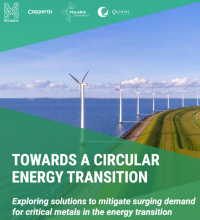
Concern continues to grow regarding the availability of critical metals. Such rare or scarce metals, like lithium or cobalt, are not only vital to the world’s major economies. They are also crucial for a transition to a renewable energy system in the Netherlands. At current levels, the global supply of these metals is insufficient, and the Dutch demand for them is no exception.
This study Towards A Circular Energy Transition serves to provide insight into the demand for critical metals domestically over the next few decades, to offer perspectives on how to reduce this demand, and to demonstrate the opportunities these new measures present to industry in the Netherlands.
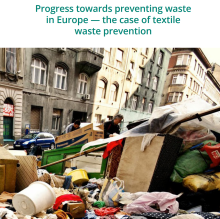
Waste prevention is the best waste management policy option, according to the waste hierarchy - the EU's main rule for the environmental ranking of waste management policies. Its main objective is to reduce waste generation, the environmental impacts of waste management and the hazardousness of the waste generated.
To support this objective, the EU and all its Member States have put in place legislation that promotes activities in products' life cycles aimed at reducing the amount of waste generated.
This report aims to assess progress towards the main objective of waste prevention: decoupling (i. e. breaking the link between waste generation and economic growth).
This briefing provides a snapshot of the status of trading non-hazardous, recyclable waste within the EU. Its aim is to provide knowledge and information to support the review of the EU's Waste Shipment Regulation.
The idea is to improve the functioning of secondary material markets by offering insights and potential solutions to help ensure that waste is treated in the best possible way in line with the principles of the waste hierarchy.
In ‘Vision 2050. A long-term strategy for Flanders’, the circular economy is one of seven transition priorities. New business models play a key role in this transition.
This paper explores incentives and barriers for consumers in adopting new circular business models - such as Product-Service Systems (PSS). Eight B2C suppliers were interviewed in the sectors of coffee, housing, electrical appliances and clothing.
The study confirms that PSS are context-dependent and emphasises the dynamic relation between producers and consumers in PSS.
Future research priorities include uncovering practical and cultural aspects of PSS, as well as exploring what it takes for PSS to be transformative in the context of a transition towards the circular economy.
This report assesses how the circular economy contributes to reaching climate goals with regard to residential housing.
The draft Flemish climate policy plan covers the operational phase of housing and the material and carbon footprints of building and renovation. The report explores two ways to reduce these footprints: reducing the size of new housing and splitting existing buildings, and applying alternative construction methods or building materials and increasing the use of recycled and reused materials.
This report details the research conducted by the Steunpunt Circulaire Economie, covering the results of a consumer survey with over 2000 respondents, as well as four interviews with car-sharing companies and interest groups.
The main objective is to get a better understanding of the position of car-sharing in Flanders, what people think of car-sharing, including the barriers people face, and what impact car-sharing is having on behaviour and the environment.
The report concludes with a set of implications and recommendations for policy relating to car-sharing and its place in the circular economy.