Local initiatives exemplify the power of entrepreneurship and grassroots action in expediting the shift to closed-loop plastics value chains. How can we leverage the potential of local circular plastics initiatives in driving the worldwide transition to a circular economy? This hybrid event is an accelerator session of the World Circular Economy Forum 2023.
This paper analyses CE policies and discourses in three European cities to draw critical insights and recommendations.
It first reviews the academic literature on urban CE policies to develop a new conceptual framework for analysing CE discourses and policies. This is then used to analyse and compare the CE policies of Glasgow, Amsterdam and Copenhagen.
Results show that technocentric approaches to the CE are dominant in the three cities. Moreover, they have very limited social justice policies for fair distribution of the costs and benefits of a CE transition. Key policy recommendations to address these shortcomings are thus proposed.
The insights offered by this paper are valuable for practitioners and academics seeking to improve urban CE policies.
The GO-GRASS project is organising a partner event on 8 June, during EU Green Week 2023. It will explore new circular business models and skills that can enhance the resilience of rural communities, focusing on green biorefineries, funding instruments and good practices in the context of grassland opportunities.
The collaborative platform Economiecirculaire.org aims to organise knowledge about the circular economy and mobilise actors at regional, national and international level (French regions, Quebec, the Canton of Geneva and the southern Mediterranean).
Created in 2014 by CIRIDD, it is intended for all professionals able to implement, encourage or support projects on this topic (local authorities, companies, developers, consultants, experts, associations, etc.). It comprises 12 regional platforms.
Eclaira is the regional collaborative platform dedicated to the circular economy in the French region Auvergne-Rhône-Alpes. Managed by CIRIDD, it aims to:
Shine a spotlight on initiatives carried out in the region
Encourage collaborative projects in the circular economy
Promote the implementation of the circular economy in the region
The platform enables users to stay abreast of circular trends and events, network, forge partnerships and join projects, use tools and tell other people what they have been doing.
It publishes technical reports and focuses on three areas: water, biodiversity and textiles, tackling each from the perspective of the circular economy. There is also a toolbox.
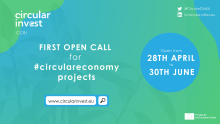
The CircularInvest project, approved under the Circular Cities and Regions Initiative (CCRI), launched its first open call for circular economy projects on 28 April. CircularInvest will help circular projects become investment-ready and access financial resources through free, tailor-made support delivered by experts. CircularInvest's services will improve the selected projects' circularity, provide a business plan and guide them through the process of securing funding. Circular project promoters will also have the opportunity to participate in knowledge transfer and networking events and live pitch sessions with potential investors.
A new initiative, CircularInvest, approved under the Circular Cities and Regions Initiative (CCRI), aims to help circular projects become investment-ready and access funding.
The short "Making Your Project Investment-Ready - Project Pitching Session" on 17 May 2023 at 11:00 CEST will provide a snapshot of CircularInvest’s free project development assistance services and details on the first call for expressions of interest through which circular project promoters can apply to access these services.
The event will also give participants the opportunity to get acquainted with one of CircularInvest’s services and prepare them to pitch their circular economy projects to investors.
Closing the green skills gap is crucial to enabling a circular economy. Circle Academy is a gamified e-learning platform that boosts mass adoption of these skills.
Rare earth elements (REEs) are among the key critical raw materials required for the green and digital transitions. Unfortunately, the EU has to import what it needs, mostly from China. Permanent magnets – one of the largest applications of REEs – are important components for a number of technologies, including wind turbines, electric vehicles, e-bikes, white goods and consumer electronics.
Although recycling processes have potential for meeting some of the future demand for permanent magnets, they have not yet developed at scale in the EU due to several existing barriers. This event on 15 June will bring together experts along the permanent magnets recycling chain and policy makers to discuss how to develop a recycling chain for rare earth permanent magnets in the EU.