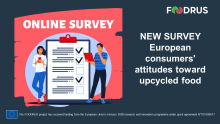
Researchers from the Food Design and Consumer Behaviour section of the University of Copenhagen are currently conducting a survey as part of the EU-funded FOODRUS project. The main objective of this research is to learn more about how European consumers feel about upcycled foods and what prevents them from consuming this type of food. All citizens are invited to fill out the questionnaire.
Is your country developing and implementing a national circular economy strategy? This is a unique opportunity to get your recipe book ready for creating a national circular economy strategy!
Finland, together with Germany, the Netherlands, the United Nations Environment Programme (UNEP) and the European Environment Agency (EEA), is organising a hybrid Accelerator Session on 1 June in connection with the World Circular Economy Forum (WCEF) in Helsinki.
Many consumer products pose significant waste management challenges and end up in landfill or incinerators. Using findings from an European Environment Agency study, the event "Headache fractions in mixed municipal waste" on 11 May will discuss these issues and what needs to change to increase recycling and promote circularity.
The European Circular Economy Stakeholder Platform (ECESP) is a joint initiative by the European Commission and the European Economic and Social Committee. It is a European one-stop-shop for the circular economy community: a place for dialogue and a bridge between existing circular economy initiatives.
The ECESP's 24-member Coordination Group, whose mandate started on 1 May, has now published its work plan for 2023.
The Navigation Tool is designed to explain the different steps in the plastic recycling process, from collection through sorting to reuse.
It gives information on the TRANSFORM-CE project’s findings, shares links to project reports and publications, gives the contact details of the project’s partners for questions or collaboration, explains IEM and AM, and suggests uses for recycled plastics.
In this video marking the end of his mandate as EESC vice-president, Cillian Lohan - who is also actively engaged in the European Circular Economy Stakeholder Platform - reminds us of the role of the circular economy.
The BUS-GoCircular project aimed to foster a green energy workforce in the construction sector. It was funded by the EU’s Horizon 2020 Research and Innovation Programme, and ran from September 2021 to March 2024.
The project produced a huge amount of training materials, such as the Train the Trainers’ programme guide. All of them can be consulted on the project home page.
The United Nations Economic Commission for Europe (UNECE) invites representatives of the public sector, companies, startups, business incubators, accelerators and higher education institutions to participate in a survey on innovative entrepreneurship for the development of a circular economy in their countries.