IUCN is a union of government and civil society organisations working to advance sustainable development and create a just world that values and conserves nature.
Created in 1948, it is now the world’s largest and most diverse environmental network, harnessing the knowledge, resources and reach of over 1 400 member organisations and 17000 experts. This makes it the global authority on the status of the natural world and the measures needed to safeguard it.
The European Regional Office represents IUCN at EU level and works with Member States to help deliver EU goals.
IUCN brings expertise and convening power on biodiversity and nature-based solutions to the table, aiming to bridge the environmental priorities of nature conservation and the transition from a linear to a circular model.
Maria Nikolopoulou, member of the European and Economic Social Committee and keen supporter of circularity, reflects on the circular economy as a recipe for success in an article published on Open Access Government.
Major Cities in Europe - like Budapest, Copenhagen, Helsinki, Ljubljana, Oslo, Prague and Tirana - have signed the European Circular Cities Declaration inviting peers to join them! The have committed themselves to leading the circular transition and to new models of production and consumption, whilst improving human wellbeing and reducing emissions.
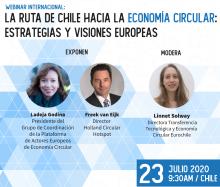
On 23 July 2020, Chile, The Netherlands, and Slovenia are again joining forces to create a circular future, discussing how to achieve sustainable recovery in Chile and what is the role of the circular economy.
The webinar is organised in the context of the United Nations High-Level Political Forum (HLPF) on Sustainable Development. It will look into practical ways to accelerate a just transition to a circular and carbon-neutral economy in order to achieve the Sustainable Development Goals (SDGs), while engaging all sectors of the economy and society.
The webinar session titled "Artificial Intelligence and Circular Economy" is part of a series of online events by Tondo. It will held on 9 July 2020 at 6 p.m. (in English with the support of slides).
Public consultation on boosting the renovation of buildings across the EU launched by the European Commission in order to gather views and input from a broad range of stakeholders, including national, regional and local authorities, businesses, unions, civil society organisations, education organisations, consumer groups, research and innovation organisations, as well as individual citizens.
Society and businesses are becoming increasingly aware that the resources needed for products are not infinite. There is growing pressure on the availability of resources due to a variety of factors including the expected increase in global consumption of goods spurred by a growing global middle class.
The report aims to introduce the various business risks of common ‘linear economy’ business practices and start a dialogue with the financial and business community about their implications. Building on this report, there is an objective to explore further directions to better understand and model them. Hopefuly, these risks will one day become an integral part of investment decisions to ensure better investment decisions that achieve long-term stability and growth.