The Circular Bio-based Europe Joint Undertaking is a €2 billion partnership between the EU and the Bio-based Industries Consortium that funds projects advancing competitive circular bio-based industries in Europe.
See the details of the new call for project proposals!
Scaling circular business models will help the EU achieve its objectives of competitiveness, circularity, resource security and resilience. However, these models have yet to be taken up widely across Europe.
Circular business models can be scaled in three main ways: scaling out (expanding customer numbers); scaling up (influencing structural conditions to support broader adoption); and scaling deep (inducing cultural and behavioural shifts).
Critical thresholds to scaling can be identified: a minimal viable scale; a niche scale; and a transformation point.
There are five key enablers for scaling: regulation and other policies; technological innovation; finance and insurance; social innovation and behavioural change; and supply-chain and ecosystem collaboration.
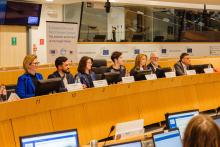
Our conference brought together EU institutions, civil society, academics, industry and young people to discuss all aspects of the circular economy, from legislation to social impact. Our new Coordination Group members shone as they spoke about the areas in which they are experts. Read about some of the major themes!
Digital Product Passports are designed to provide reliable product data supporting sustainability, circularity, value retention for re-use, remanufacturing and recycling.
This company is developing a software-as-a-service solution for EU SMEs, enabling them to produce DPPs quickly and easily.
This report presents the results of a joint research project by the European Investment Bank Group and the European Commission (DG ENV) to assess the circular economy investment gap in the EU.
Annual investments have reached around €120 billion but there is still an investment gap of around €82 billion per year between 2025 and 2040. Gaps are most significant in circular design and end of life infrastructure, and in key sectors such as construction, batteries and vehicles, and textiles.
The report highlights persistent market failures and investment barriers and outlines how EU regulation can help markets to develop and how coordinated EU and EIB financing and advisory action can mobilise investments and accelerate Europe’s circular transition.
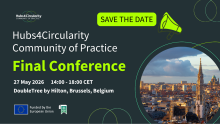
The Hubs4Circularity Community of Practice is a network of partners from industries, regions and cities, set up under Horizon Europe to facilitate building, scaling up and replicating of ecosystems of industrial and industrial-urban symbiosis, and circular economy.
Come and learn about Hubs4Circularity initiatives and engage with experts and stakeholders from industry, regions and cities, policy, research and innovation!
PRIMED is a European project that aims to redesign the primary sector to maximise bioeconomy development through the creation, validation and scaling of circular and regenerative bio-based value chains.
It has already mapped the main biomass feedstocks and conversion technologies across its five labs and the bio-based value chains developed there.
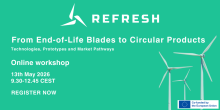
REFRESH is a European project aiming to develop and demonstrate a novel circular, smart system enabling improved recycling of glass fibre reinforced composites derived from wind turbine dismantling or reblading.
This event will show how they are progressing towards this goal.