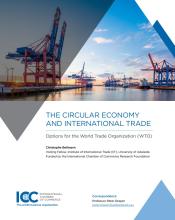
This study highlights that, while international trade has a vital role to play, policy responses to-date have largely been designed at the national level and in an uncoordinated manner.
ICC Secretary General John W.H. Denton says that "the report shines a light on how well-intentioned national policies are inadvertently hindering the adoption of circular solutions in the real-economy. Simply put: the transition to a circular economy can only be enabled at scale by harnessing the power of cross-border trade to unlock economies of scale and comparative advantages. We hope our analysis will serve as a clarion call for a concerted global effort under the auspices of the World Trade Organization to enable new patterns of trade capable of meeting global climate and sustainability goals".
Recycling is key for the circular economy. Chemical recycling could one day become a trouble-shooter solution for any remaining unrecyclable applications and replace incineration. However, it is not yet a sustainable technology.
Ecopreneur.eu - the European Sustainable Business Federation - has concerns about linear economy lock-ins, high CO2 emissions, competition with mechanical recycling, lack of scale, low quality, toxic residues and large investments being drawn away from SMEs going circular.
Therefore it advocates supporting the development of chemical recyclingonly if it is:
net-carbon positive,
used for otherwise unrecyclable residues,
with maximum quality,
scalable,
at costs reflecting the waste hierarchy, and
matched by equal support for SMEs on circular design.
The ECESP Coordination Group members will present Europe's pioneering work in the field of the circular economy to a global audience on 17-18 January 2022 during the Europe Circular Days in Dubai. European Commissioners, MEPs, and other EU institutions' representatives will join the event to present Europe's vision for the circular economy.
In many countries, the government is the single largest purchaser of products, services and works. Green Public Procurement (GPP) enables governments to reduce the environmental impact of their purchases. It also serves as a powerful tool for governments to simultaneously achieve their environmental and development policy objectives.
This report provides an overview of international experience in the implementation of GPP. It focuses on the institutional framework that is needed to support the mainstreaming of GPP practices across governments. The intention is to equip practitioners with a broad understanding of the issues they need to consider in the design and implementation of GPP reforms.
A historic decision has been announced at the Catalonia Circular Hotspot Event 2021! The 2023 edition of the Circular Economy Hotspot will be hosted by Nigeria, Ireland, and Chile!
The French National Institute for Circular Economy (INEC) has published this paper which aims to use schools - a place familiar to all - as showcases for the circular economy. It contains a series of good practices (for public and private actors, youth) comprising over 40 territorial initiatives and 50 operational solutions, on the following themes:
school buildings (construction, renovation)
energy supply
inner/outer spatial planning
stationery-equipment-furniture
school cleaning (products and apparel, staff training)
food loop (local and sustainable food, waste, water fountains)
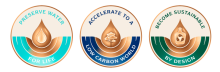
Reduce water use in Diageo's operations with a 40% improvement in water use efficiency in water stressed areas and 30% improvement across the company.
Other (Sustainable management of water)
To be achieved by:
Replenish more water than Diageo uses for their operations for all their sites in water-stressed areas by 2026.
Other (Sustainable management of water)
To be achieved by:
Invest in 150 projects to improve access to clean water, sanitation, and hygiene (WASH) in communities near Diageo sites and local sourcing areas in all of Diageo's water-stressed markets.
Other (Sustainable management of water)
Start Date:
Engage in collective action in all of their Priority Water Basins to improve water accessibility, availability and quality and contribute to a net positive water impact.
Recycling (also including specific waste streams)
To be achieved by:
Achieve zero waste in Diageo's direct operations and zero waste to landfill in Diageo's supply chain.
Recycled materials as part of raw materials demand (recycled content)
To be achieved by:
Ensure 100% of Diageo's packaging is widely recyclable (or reusable/compostable).
Recycled materials as part of raw materials demand (recycled content)
To be achieved by:
Continue to reduce packaging and increase recycled content in Diageo's packaging (delivering a 10% reduction in packaging weight + increasing the % recycled content of the packaging to 60%).
Recycled materials as part of raw materials demand (recycled content)
To be achieved by:
Ensure 100% of Diageo's plastics are designed to be widely recyclable (or reusable/compostable) by 2025 and achieve 40% recycled content in Diageo's plastic bottles by 2025, and 100% by 2030.
Other (Sustainable agriculture management)
To be achieved by:
Provide all of Diageo's local sourcing communities with agricultural skills and resources, building economic and environmental resilience (supporting 150,000 smallholder farmers).
Other (Sustainable agriculture management)
To be achieved by:
Develop regenerative agriculture pilot programmes in 5 key sourcing landscapes.
Other (Accelerate to a low carbon world)
To be achieved by:
Become Net Zero carbon in Diageo's direct operations.
Other (Accelerate to a low carbon world)
To be achieved by:
Reduce Diageo's value chain carbon emissions by 50%.
Other (Accelerate to a low carbon world)
To be achieved by:
Use 100% renewable electricity across all of Diageo's direct operations.