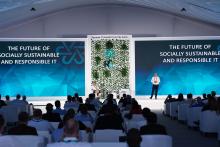
From 15 to 18 April, circular economy professionals from 168 countries came together at WCEF2024 to collaborate and turn ideas into action.
The Summary Report takes stock of the event: it presents the findings and key takeaways, including reports, tools and calls to action launched at the forum by partners, discussion highlights and key statistics.
Wales (Cymru in Welsh!) will be hosting the 2024 European Circular Economy Hotspot: Circular Economy Hotspot Cymru 2024.
The summit will take place on 7-9 October in Cardiff. It will be an opportunity to share Wales' circular economy achievements and aspirations, and learn about circular economy solutions from the public sector, private sector and communities from Wales and beyond.
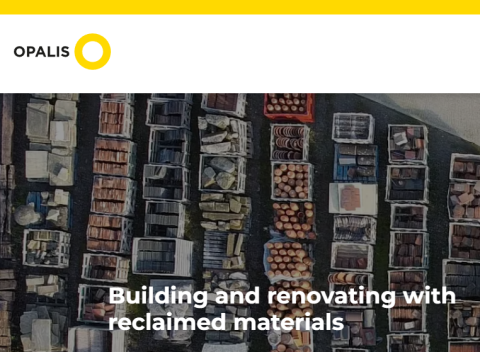
An overview of professional retailers who sell recovered building materials. These operators often offer other services as well, such as dismantling and cleaning, tailor-made components and specialised advice.
Technical documentation on the most common construction products on the reuse market.
Recent projects in which reuse materials have been applied successfully and inspiringly.
Useful documents and links for visitors who want to gather additional infomation.
Circe.med is a network of Mediterranean organisations involved in the transition towards ecologically and sustainable ecosystems. Established at the start of 2024, it wants to help deliver a carbon-free, circular economy which will improve people's quality of life.
The initiative aims to deepen, promote and implement a circular economy based on efficient and reduced use of natural resources.
Three main strands:
Sustainable food
Tourism and plastic in coastal areas
The built environment
The network's member organisations strive to deliver an effective circular economy in the Mediterranean which will benefit their individual ecosystems and the region as a whole.
The network is supported by an online platform, Circemed.org, which promotes cooperation and acts as a resource centre.
This conference is an opportunity to meet the public authorities and companies involved in the circular economy in the French Drôme Ardèche region.
There will be a main session on a circular and cross-cutting approach for tomorrow's economy, a round table discussion on the regional donut in Valence Romans, five workshops and three site visits.
This workshop, organised by GENIE, will explore a very practical case study of materials reuse. There will be a guided tour of a building where offices are going to be converted into housing as part of a project by the real estate group SPS, the architects' office FdMP and the Matériuum association.
The workshop will see how reuse in the construction sector is coming along in the French-speaking part of Switzerland and explore the impact and technical and economic feasibility.
EFPIA, the European Federation of Pharmaceutical Industries and Associations, supports the principles of the Circular Economy Action Plan.
In the healthcare industry, circular opportunities could be centred around eco-design of products, packaging & devices, and end of life; circulation of products and materials to maximise the value of resources; reduction of reliance on single-use plastics, regeneration of natural systems by preserving finite materials and exploring renewable resources and associated services; suppliers and customer engagement for equipment return.
Safe and sustainable closed-loop recycling within the industry is the goal, but where this is not yet feasible, these valuable materials must be circulated as secondary raw materials for other sectors.
The Sustainable IT Summit took place on 23 April in the United Arab Emirates, organised by Circular Computing which, unsurprisingly, is endeavouring to promote circularity in the IT sector. The summit was attended by IT industry leaders who discussed sustainability challenges in this sector and the opportunities offered by circular processes such as remanufacturing.
The general consensus was that remanufacturing and acceptance of reused devices is inevitable: 20% of enterprise laptops bought will be pre-used in a few years.
Flexible packaging provides lightweight, efficient protection for various products. Given just how important it is to recycle packaging, FEICA has published a report taking stock of how laminating adhesives meet design-for-recycling guidelines and how sortability and recyclability testing relate to flexible plastic packaging.
Highlights:
What are laminating adhesives and why are they important for plastic packaging?
What are the challenges and criteria for recycling flexible plastic packaging?
How are laminating adhesives reflected in design-for-recyclingguidelines and what are the sortability and recyclability test methods for flexible plastic packaging?
How to enhance recyclability for adhesive applications, and future prospects.
World environmental challenges such as climate change and biodiversity loss pose considerable risks to health and well-being. Linear resource extraction and processing account for half of total greenhouse gas emissions and more than 90% of biodiversity loss and water stress. Institutional and European stakeholders agree that transitioning to a circular economy could help solve these existential crises.
With the coming change in the European political landscape, the members of the Coordination Group of the European Circular Economy Stakeholder Platform want to flag up this issue to incoming legislators and advocate keeping the Green Deal and the circular economy as a primary focus for the next Commission and European Parliament.