The Policy Hub (founded in 2019) aims to promote circularity in the apparel and footwear industry and propose policies that accelerate sustainable practices. It represents over 700 stakeholders and has partner organisations:
It looks at each stage, focusing on ways to reduce the environmental impact and considering end of life. The Policy Hub seeks to encourage an ambitious policy framework to speed up the transformation of the apparel and footwear industry towards circularity. It focuses on:
To help inspire conversation and policy action concerning inclusive circular business models during the next EU Commission mandate, RREUSE invited EU decision makers to a closed site visit toLes Petits Riens, a Brussels-based social enterprise with activities dating back to 1937.
These factsheets outline circular economy opportunities to design out urban waste and pollution, ensure products and materials maintain their value, and regenerate the natural systems in our cities.
Easy-to-reference, the factsheets are a collation of research and case examples that answer some of the most prevalent questions around what circular economy can bring to cities:
Why is change in cities needed?
What circular economy opportunities address key urban system issues?
What can urban policymakers do to harness circular economy opportunities?
What are the potential economic, social, and environmental benefits of these opportunities?
Waste and pollution from the production of textiles and clothing have become critical global issues. This report launched by Ecopreneur.eu and the European Sustainable Business Federation calls for decisive policy measures based on 5 pillars:
Innovation policies: funding research programmes, investment tax deduction, support for technological development and SMEs.
Lena is the first fashion library of the Netherlands, where you can borrow clothing with a subscription, or buy through the try-before-you-buy principle. An endless wardrobe with the benefits of a fast changing wardrobe, placed in a sustainable context.
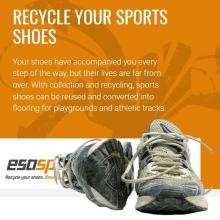
esosport was founded in 2009 by a small group of avid sports fans keen to find a better use for old sports shoes than simply throwing them away. They have proven that once they have exhausted their support and performance potential, recycled sport (and bike tyres!) shoes yield a secondary raw material which is very good for flooring in sports facilities.
Waste and pollution from the production of textiles and clothing have become critical global issues. The current ‘linear’ model is outdated and unsustainable. There is an urgent need for a strategy to transform industry into a circular model. A new report launched by Ecopreneur.eu, the European Sustainable Business Federation, calls for decisive policy measures to create an enabling framework.
Rifò regenerates noble textile fibres, such as cashmere, using a proven technology developed in the textile district of Prato (Tuscany) over a hundred years ago.
After the 2014 elections, the new Roubaix municipality team wanted to change the image of its city and encourage a positive attitude towards both its inhabitants and France as a whole.
The roadmap aims at turning difficulties into advantages, generating a new dynamic. Based on theSustainable development strategy (since 2003), a zero waste policy is progressively implemented with a focus on cooperation and awareness raising among stakeholders.
The approach is global, even if some activities are implemented on a micro-scale (budget issue), mostly at the level of a city sub-district (Fresnoy-Mackellerie).
To enable the entire City of Roubaix to experience the transition to a zero waste economy, projects are open and accessible to all categories of population and businesses.