In view of the ongoing regulatory developments in the field of the Packaging and Packaging Waste Regulation, this in-person event on 4 July will discuss the potential of using chemical recycling technologies as part of an ecosystem of solutions for increasing circularity of plastics.
The first episode of the Biocircularcities Trilogy unveils the story behind the success of the BBI-JU Biocircularcities project or how partners supported a transition of the pilot territories toward circular bioeconomy through a collaborative approach.
On 27 June 2023, the Zero Pollution Stakeholder Platform (ZPSP) will host the first in a series of Zero Pollution Talks. The launch event on "Zero Pollution & the European Year of Skills" will be held online on 27 June at 15:00 – 16:00 CEST.
These online events are intended to foster stakeholder engagement and knowledge exchange with a view to raising awareness and tackling a wide range of issues related to zero pollution, including circularity. The Talks will bring together a diverse set of stakeholders, including experts and policymakers, for an hour-long, online interactive discussion. The sessions will be recorded to create a zero pollution knowledge base.
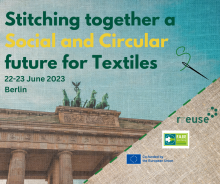
This event, organised by RREUSE on 22 and 23 June with the support of FairWertung, will bring together leading experts, social entrepreneurs, policymakers, and social enterprise leaders to discuss the current state of the textiles market and explore innovative ways to increase re-use and reduce textile waste.
Smart Circular Economy is an international IEEE workshop focusing on the role of ICT as an enabler for Circular Economy. It brings together scientists, researchers, as well as relevant stakeholders from the industry and local communities to share and exchange their experiences, discuss challenges, and report state-of-the-art and in-progress research lying in the intersection of ICT and Circular Economy.
Rare earth elements (REEs) are among the key critical raw materials required for the green and digital transitions. Unfortunately, the EU has to import what it needs, mostly from China. Permanent magnets – one of the largest applications of REEs – are important components for a number of technologies, including wind turbines, electric vehicles, e-bikes, white goods and consumer electronics.
Although recycling processes have potential for meeting some of the future demand for permanent magnets, they have not yet developed at scale in the EU due to several existing barriers. This event on 15 June will bring together experts along the permanent magnets recycling chain and policy makers to discuss how to develop a recycling chain for rare earth permanent magnets in the EU.
On 23 May, the AL-INVEST Verde Programme, funded by the European Commission for promoting sustainable growth and job creation in Latin America, launched its second call for proposals. Join the information session and discover more about the programme and the call terms and requirements.
Two online information workshops (on 5 and 13 June) will be organised for associations, chambers of commerce and other institutions representing the private sector, research centres and think tanks. During the workshop, an overview of the programme as well as full information on the second call will be presented.
Some circular economy practitioners believe that switching to biomass is the best way to implement the circular economy. However, the circular economy is not synonymous with bioeconomy. The circular economy is about retaining the value of materials for as long as possible, and consequently it cannot be achieved simply by adding more and more primary biomass to the economy. Demand for biomass is increasing rapidly yet supply is limited, leading to problems for climate and biodiversity.
Join our panellists on 13 June at 10:00 - 11:30 CEST to discuss the intersections between the circular economy, bioeconomy, climate change and biodiversity. The event will explore the circular economy's role in balancing biomass supply and demand and reducing negative impacts on biodiversity and climate change.
Do you struggle to find the needed resources to set up and commercialize innovative circular economy projects? This workshop on 13 June provides an overview of different funding sources available for circular innovations and of the criteria to be fulfilled in order to tap into them.
The speakers:
Thomas van Nieuwenhuizen, EGEN
Annika Kossack, EISMEA
Céline Rottier, European Investment Bank
Javier Rodrigo Aznàrez, Regional Government of Navarra
EU Green Week is the annual opportunity to debate, become familiar with, or even celebrate EU environment policy. This year's edition takes place between Saturday 3 June and Sunday 11 June.