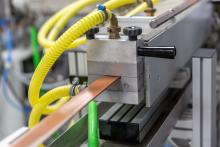
AIMPLAS has developed a device which demonstrates how the Digital Product Passport for plastic products will work. This tool provides essential information about the traceability, materials, recycling and carbon footprint of products.
TCO Certified has over 30 years' experience of driving sustainable development in the IT industry. By continuously developing criteria and verification methods, it tackles new challenges such as circularity, hazardous substances, and socially and environmentally responsible manufacturing.
RedGirraffe ESG Horizon is a software as a service solution designed for enterprise resource planning. It supports the circular economy by enabling precise tracking and optimisation of Scope 3 emissions across global supply chains.
Recycling flexible PET packaging is tricky because it is made up of layers but in Spain, recycled polyethylene terephthalate (rPET) is the only type authorised for post-consumer recycled content for food packaging.
The BOTTLE4FLEX project has taken up this challenge and aims to develop 100% recyclable flexible skinpack packaging using rPET.
The ECOFAP project aims to make shoe soles and heels from a material manufactured from tanned leather waste using 3D printing. This research project will help solve the problem of how to recycle leather scraps from the footwear manufacturing industry.
How many plastic bottles actually enter the recycling process?
Theory is one thing and reality tends to be another. The Czech Ministry of the Environment wanted to find out what really happens to plastic bottles after they are thrown into sorted bins for plastic waste. It commissioned Adastra to carry out a project using IoT technology to track the movement of sorted bottles.
The Horizon Europe POLYMEER project aims to establish a sustainable bio-based value chain for bioplastic products. By efficiently converting wet brewers’ spent grain into high added value materials, it is endeavouring to diversify the array of innovative material solutions capable of replacing traditional plastics.
The SCALE-UP project helps regional multi-actor partnerships identify and scale-up innovative, sustainable bio-based value chains that build on regional resources.
It aims to adapt, implement and evaluate tools to help regional actors overcome bottlenecks towards fully exploiting circular bioeconomy potential. In this way, it will promote regional, rural, local/urban and consumer-based transitions towards a sustainable, regenerative, inclusive and just circular economy and bioeconomy across all regions of Europe.
The RECERCO project recovered fired sherds, a form of waste generated when manufacturing ceramic tiles. It proved that it is feasible to use this as a secondary raw material for manufacturing new ceramic tiles and as a reinforcement agent for polymeric matrices to obtain composites for the construction industry.
PRIMUS was a research project funded under the Horizon Europe programme, which ran from 2022 to 2025. It researched new polymer recycling technologies, with a view to producing new recycled materials that meet the requirements for manufacturing high value products.
It produced a webinar series on Boosting Plastic Recycling and a number of training courses.