The ASEAN Circular Economy Stakeholder Platform (ASEAN CE Platform) is a regional facility helping Association of Southeast Asian Nations Member States achieve sustainable consumption and production by accelerating the transition to a circular economy.
The EU-ASEAN Strategic Partnership covers the circular economy, and the Platform is part of the EU-ASEAN Partnership on Circular Economy, endorsed by ASEAN Senior Officials on the Environment in 2018. The ASEAN CE Platform is hosted by the ASEAN Centre for Sustainable Development Studies and Dialogue at the College of Management, Mahidol University in Bangkok, Thailand.
The establishment of the Platform was inspired by the success of the European Circular Economy Stakeholder Platform in providing access to CE good practices and strategies.
This initiative will provide selected households with a cost-free circular economy advisory service. Firstly, all available knowledge about measuring and calculating households' greenhouse gas emissions and other environmental impacts will be screened and consolidated. A simple and robust method for quickly comparing environmental impacts will then be established, drawing on product environmental footprint expertise.
The European Commission's Horizon Europe Framework Programme has launched a call for the circular economy and bioeconomy sectors, with particular reference to circular systemic solutions under the Circular Cities and Regions Initiative (CCRI).
In this context, a circular systemic solution is defined as a demonstration project for deploying a circular and climate-neutral economy at urban and/or regional scale, involving key stakeholders and, ideally, addressing more than one product value chain. Proposals are expected to implement and demonstrate at large scale circular systemic solutions for the deployment of the circular economy (including the circular bioeconomy) in cities and regions or their groupings. They should form part of the implementation of the European Commission's Circular Cities and Regions Initiative (CCRI) and should be carried out in close coordination and cooperation with the CCRI Coordination and Support Office (CCRI-CSO).
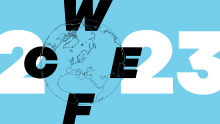
The World Circular Economy Forum 2023 will be held in Helsinki from 30 May to 2 June 2023. This global collaboration forum is co-organised by Finnish Innovation Fund Sitra and Nordic Innovation, with international partners. It will attract more than 2 000 leading circular economy players in the world to Finland to find circular solutions that can help our economies fit within the boundaries of nature. Part of the programme will also be accessible online.
The ECESP is pleased to share with you the issue paper assembling the key takeaways of the November 2022 event How can EPR promote sustainable consumption and production?
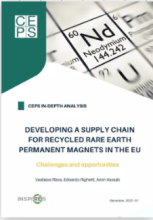
Rare earth elements are strategically important for the EU to sustain and accelerate its green and digital transition, particularly due to their use in permanent magnets. Rare earth permanent magnets are critical components in wind turbines and electric vehicles, as well as home appliances and consumer electronics.
However, faced with an expected surge in demand, limited domestic manufacturing capacity, high import dependency and rising geopolitical tensions, the EU’s ability to meet the future demand for rare earth magnets is at risk.
This report examines the barriers hindering the establishment of a viable magnet recycling chain in the EU, whilst estimating the extent to which recycling could offset the coming increase in demand for rare earth magnets.
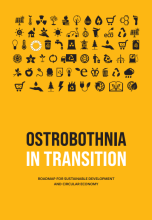
The roadmap for Ostrobothnia (Finland) provides practical examples on how to get started or develop sustainable thinking, based on the latest research and current trends. The focus is on developing concrete guides, tools and checklists to make the change easier for entrepreneurs.
Get started - Focus on sustainability
Facilities & energy - Less is more?
Raw materials - Everything starts from the choice of materials
Design & product development - Right from the start
Purchases - Have courage to set strict requirements
Production & manufacturing - Produce for the future
Transports & distribution - The closer the better
Communication & marketing - Tell!
Sales - New requirements
Waste & recycling - Go through your waste recycling
During a hybrid seminar organised by Foodvalley NL on 14 February 2023, questions concerning, for example, the consumer's perceptions and expectations on upcycled food will be tackled and the potential impact of circular food concepts by creating an optimal outreach to the market and the consumer will be explored with the help of experts of the Upcycled Food Association (UFA) and Innova Market Insights, and several partners of the Upcycling Community.
Annual Conference 2023: Recovery, Open Strategic Autonomy and Resilience
The European Commission and the European Economic and Social Committee will host the 2023 European Circular Economy Stakeholder Conference on 27 and 28 February 2023.
Plastic is used in many ways and in large quantities across Europe. Environmental concerns make this a key focus for policy. Currently, most policy actions focus on plastic packaging, even though a large proportion of plastics are used for non-packaging applications, such as construction, furniture and consumer electronics.
Improved reporting on the flows of non-packaging plastics is needed to inform the development of effective policies and measures that target this significant waste stream and increase resource efficiency, in line with the aims of the Circular Economy Action Plan.