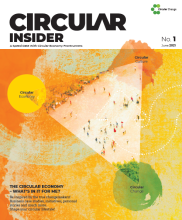
This is a crucial time for shaping the Circular Economy in Ireland. The country's draft Whole of Government Circular Economy Strategy is currently open for public consultation and will be discussed live on Instagram on Wednesday 26 May 2021 at 14:30 IST (UCT+1).
Virtual MeetingPack 2021 is taking place on 27 May from 9:30 a.m. More than 130 packaging industry companies have confirmed their attendance at this event offering a strategic overview of the development of barrier packaging.
The new Circular Economy Action Plan identifies textiles as a key product value chain with potential to boost the EU market for sustainable and circular textiles. The European Commission is organising a series of targeted stakeholder workshops to gather input on challenges and gaps as well as opportunities for the sector towards sustainability. Join the second workshop on 2 June 2021!
The European Environment and Sustainable Development Advisory Councils Network brings together advisory bodies offering independent advice to national or regional governments and parliaments on climate change, environment and sustainable development.
The vast majority of EEAC members work in particular on the transition towards a circular economy model. With representatives from academia, civil society, the private sector and public bodies, the EEAC network brings together experts with years of experience producing analysis and recommendations that should enhance the shift to a circular economy at sub-national, national and EU level.
ReBlend develops textiles and textile products made from textiles that otherwise end up in incineration. Textiles made from recycled fibres offer a positive alternative for designers and companies. In collaboration with waste collectors, producers, designers, makers and visionaries, ReBlend organises a full supply chain from start to finish to accelerate a new ecosystem for circular textiles.
Green Tech Valleyis a technology hotspot for climate protection and the circular economy. It has over 2300 scientists working on green solutions. It is home to over 600 green technologies and services for renewable energy and the circular economy, with an emphasis on recycling.
The Green Tech Valley Cluster drives the development of green innovation in the Green Tech Valley through match-making and knowledge transfer. It links up businesses with contacts in the green tech sector.
The platform has a directory of projects, which can be used to identify potential partners. The projects are categorised by theme, including Circular. It also has a section on courses for green skills.
“Staramaki” is a straw made of wheat. It is produced by a social cooperative KoinSep in Kilkis, northern Greece. The most widely produced local product wheat is used to create a viable eco-friendly alternative to single use plastic straws. At the same time they create employment opportunities and promote social cohesion, as well as local and regional development.
"Innovative Business Practices and Economic Models in the Textile Value Chain" (InTex) is a three-year UNEP project funded by the European Union. The InTex project has five components, two with global reach and three focusing on national implementation in three African countries: Kenya, South Africa and Tunisia.
ACR+ is launching a publication on the development and implementation of circular bioeconomy strategies in different contexts, focusing on three detailed regional case studies in Navarre, Bayern and Flanders.
Under a cooperation agreement with the French Pays de la Loire region, ACR+ has set up a working group on the circular bioeconomy, with a focus on governance. The working group aims to support the development of local and regional roadmaps for the circular bioeconomy, as public authorities steer and support the development of the circular bioeconomy on their patch.
The publication is the result of activities implemented by ACR+ through the working group.