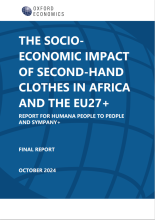
Used clothing exports from the Netherlands totalled more than €193 million in 2022: not an insignificant amount.
Understanding the realities of second-hand clothing markets in export destinations will be crucial to develop appropriate policy at national and supranational levels. The aim is to support the socially equitable and environmentally sustainable processing of used textiles, and ensure that this industry is in line with the EU's 2020 Circular Economy Action Plan and the European Green Deal.
To this end, the report explores what happens to textiles collected in the Netherlands in their various destination countries, and highlights the impacts and risks associated with these exports, as well as how they are addressed.
This briefing looks into how circular economy and waste sector policies and measures can reduce greenhouse gas emissions.
It analyses how European countries include circular economy and waste actions in their reporting on climate change mitigation policies and measures and how the introduction of additional measures can help accelerate future reductions of GHG emissions.
The briefing finds that waste management and the circular economy have considerable potential for mitigating climate change. Therefore, countries would benefit from including policies and measures in these areas in their climate policy mix.
EU policymakers recently decided to introduce a direct ban on the destruction of textiles and footwear, with some exemptions for small, micro and medium-sized companies.
In this briefing, the EEA takes stock of what is currently known about the volumes and destruction of returned and unsold textiles in Europe. The growth of online shopping, flexible return practices, changed consumer preferences and fast-fashion business strategies in Europe have resulted in increased shares of returned and unsold textiles.
Over the past years, fast fashion and luxury brands have been reported as destroying returned or unsold clothing, shoes and other textiles. Textile product destruction is a very good example of a ‘take-make-waste’ approach.
The European Green Deal is a cornerstone of efforts to achieve climate neutrality by 2050 and deliver the Sustainable Development Goals in the EU. Many policy targets are dependent on action by local and regional authorities.
The current Commission's mandate is coming to an end, and so this is a good time to kick-start discussion on the "future" Green Deal and the role of local and regional authorities in implementing it.
The European Commission’s Joint Research Centre is therefore launching a stakeholder consultation for urban policy experts and policy makers, in order to get a better understanding of policy and target priorities for EU cities.
Following a request by the Belgian Presidency of the Council of the European Union, the European Committee of the Regions is preparing an opinion on What is the role of local and regional authorities in the transition towards a circular economy? The opinion is being drawn up by Loredana Capone, president of Apulia Regional Council (Italy).
This stakeholder consultationis intended to provide Ms Capone with input for the opinion.
The BRINC(Brokering cross-border Innovation through Clusters) project is holding a workshop where participants will be able to meet the BRINC network of public authorities and other key actors working on public procurement of innovation and circular economy in order to exchange insights and learn from each other.
The New Era Buildings and Housing Festival, better known as URF, is organised by the Finnish city of Kerava in the lush surroundings of Kerava Manor.
This is the main event in Kerava's 100th anniversary celebrations: visitors can visit the festival free of charge, and if they choose they can buy a ticket for the events and concerts.
URF focuses on sustainable housing and living, providing inspiration and circular solutions for future housing.
Biorefine Cluster Europe (BCE) links up projects and people in the area of bio-based resource recovery, with a view to contributing to more sustainable and circular resource management.
It focuses on the biorefinery sector, i.e. chemicals, materials, energy and products from bio-based waste streams:
Bio-based (waste) streams as an input for the circular economy
Bioprocesses
Sustainable bio-energy production in its various shapes, and
Resource recovery: extracting minerals, chemicals, water and materials from biomass.
Its main objectives:
Strengthening interaction between projects
Fostering dissemination and stakeholder outreach
Enhancing research
Identifying gaps in knowledge.
BCE aims to build its community and promote knowledge exchange.
EuRIC, a leading voice in Europe's recycling industries, is organising an event on "Plug into sustainability: e-waste recycling", to take place on 3 June from 14:00 to 17:30 CEST, in Brussels.
It will be an opportunity to explore the latest developments and sustainable practices in e-waste recycling, bringing together industry leaders, policy makers and innovators.
On 29 February at 13:00 – 14:30 CET, the Nordic Working Group for Circular Economy will hold a webinar to present the report on 'Recycling of Critical Raw Materials in the Nordics'.
The report provides a comprehensive overview of the Nordic region's secondary value chains for CRMs.