The Ocean Package UG is a young and sustainable company from Munich with the goal to make e-commerce more environmentally friendly and sustainable. For this purpose, they have designed reusable packaging made of recycled polypropylene, which contains a proportion of collected plastic from the North Sea. Their product can be used 20 times more often than conventional cardboard packaging.
The Czech Circular Hotspot is operated by the Institute for Circular Economy (INCIEN), a non-governmental organisation that has been promoting circular economy principles since 2014.
CCH aims to facilitate cross-sectoral and international cooperation in the field of the circular economy. It wants to create a space where the public and private sector can cooperate to accelerate the transition towards a circular economy in Czechia.
The hotspot was set up in 2022, and thanks to strong partners and successful models abroad, it has rapidly grown into an effective network. Members include businesses, SMEs, start-ups, NGOs and academic bodies.
As well as networking opportunities, it provides training sessions and information on overviews and trends.
CIMPA, an EU-funded H2020 project, aimed to develop a recycling chain for post-industrial and post-consumer multilayer films from food and agricultural applications. This complex approach combines innovative compositional sorting, mechanical and physical recycling and an advanced decontamination process.
Are you an official representative of a city/region/basin in which a significant share of economic activity depends on oceans, seas, rivers and lakes? Do you wonder how to implement a RISC-proof blue economy? If so, fill in the OECD survey: Localising the Blue Economy. Towards a Resilient, Inclusive, Sustainable and Circular approach to the blue economy in cities and regions by 16/9/22.
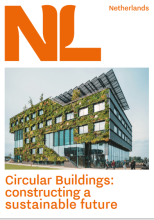
Circular Buildings: constructing a sustainable future: a new brochure which explores how the circular economy can help tackle challenges in the resource-intensive building sector.
Circular Buildings: constructing a sustainable future is the latest addition to a series of publications from Holland Circular Hotspot about circular challenges and opportunities in different sectors including infrastructure, plastics, manufacturing and textiles and apparel industries.
It explores how circular economy concepts can help tackle challenges in the building sector, supporting the transition towards a more sustainable and futureproof industry. It provides 25 good practices from the construction value chain and offers a framework for an international shift towards circular construction comprising policies, measurement standards, collaboration initiatives and knowledge exchange.
The European Commission is carrying out an impact assessment in preparation for the revision of the Waste Framework Directive. You have until 16 August to tell the European Commission what you think about waste management and its environmental impact!
The Roadmap - Towards the Circular Economy in Montenegro aims to steer the transition to a circular economy in Montenegro. It is based on systemic thinking and outlines the main drivers, horizontal and priority areas, opportunities for circular transformation and recommendations for the way forward.
The strategy identifies five focus areas (food and forest systems, the built environment, tourism and manufacturing) that are highly interconnected and, through the principles of industrial symbiosis and synergies, can result in systemic change.
The roadmap is an outcome of collaboration between the Montenegrin Chamber of the Economy, UNDP, Circular Change and Deloitte BiH.