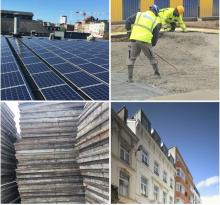
Samen werken aan circulaire fietsinfrastructuur. Een integrale en systematische aanpak by Stichting Circulair Bouwen is a report on a 2-year programme carried out with EU funds on building a circular bicycle road infrastructure. Over this period of time, valuable information has been gathered on how to promote and organize circular building efficiently.
To follow up on the programme, a multi-year project will be carried out in cooperation with governments, companies, educational institutions and NGOs, under the lead of the Radboud University Nijmegen, which will include two important policy fields:
encouraging cycling (low carbon, public health, better access to congested cities, car traffic reduction) and
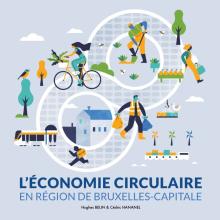
Since 2016, the Brussels-Capital Region has set the circular economy as one of its strategic priorities, and is implementing concrete actions to that effect.
Where are we today? Is this just the beginning of a major cultural shift? What are the main challenges ahead? To find out, the authors met numerous actors - public or private - on the ground to better understand the implications of 'circularising' the Brussels Region.
This brochure gives an overview of the promises and limitations for this new economic model with concrete examples, providing inspiration and grounds for further reflection on transitioning to the circular economy.
The BlueCity business park is one of Rotterdam's unique landmarks: formerly a water park resort, the complex is now a circular incubator housing over 30 startups experimenting towards a sustainable future.
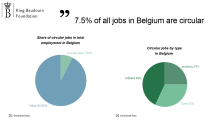
This report presents a baseline measurement of employment in the Belgian circular economy and provides insights into the nature and number of jobs in the country’s circular economy. This includes all jobs contributing to the circular economy through activities in renewable energy, repair and maintenance, recycling, digital technology, design, new business models and collaboration.
This report, conducted by the King Baudouin Foundation and the Dutch social enterprise Circle Economy, aims to inform governments, employers, social partners and other representatives with a view to pursuing effective and inclusive circular labour policy.
An online monitor, which the partners will update regularly, complements the report.
Vlaanderen Circulairis the hub and inspiration for the Flemish circular economy. It is a partnership of policy makers, companies, civil society and the knowledge community taking action together. Its six core activities are:
Bringing together partners to tackle circular economy challenges
Creating knowledge to streamline policy-related research into policy measures for the circular economy in Flanders
Speeding up innovation and entrepreneurship
Assisting pioneers
Connecting local, Flemish, federal and European policy making
Embedding circular principles across Flemish civil society.
To prevent consumers from buying items they use only a few times a year, Usitoo enables customers to rent these instead. The cooperative has a catalogue of hundreds of items that its customers can rent with credit, thus making the possession span of these items much longer.
The textile industry is the second most polluting industry in the world. The Next Closet’s mission is change this and inspire people to invest in quality and reuse what they already have, so second hand can become the number one choice.
Wolkat is an family owned group of innovative, international textile recycling companies. It is offering a circular solution for textiles. Collected textile is transformed in-house to new products through sorting, recycling, spinning and weaving. All collected textile is transformed into a final product with hardly any water or any dye, leaving only 4-5 % waste from all textiles.
The Brussels Regional Programme for a Circular Economy (CE) is Belgium's capital region strategic effort towards a CE. Within this program, the Brussels construction industry with its 12,000 businesses is a priority sector. As construction and facilities management accounts for 98% of water use, 75% energy demand and 33% of waste in Brussels, there is great potential for a substantial contribution to a circular transition.
The roadmap, developed in partnership with the Environmental Agency through 3 stakeholder workshops, includes three gradual steps towards circular building in Brussels:
voluntary measures by construction businesses by 2025
comprehensive regulation for circular public buildings by 2030
reforming all relevant local planning regulations to include circularity by 2040.