Reduce water use in Diageo's operations with a 40% improvement in water use efficiency in water stressed areas and 30% improvement across the company.
Other (Sustainable management of water)
To be achieved by:
Replenish more water than Diageo uses for their operations for all their sites in water-stressed areas by 2026.
Other (Sustainable management of water)
To be achieved by:
Invest in 150 projects to improve access to clean water, sanitation, and hygiene (WASH) in communities near Diageo sites and local sourcing areas in all of Diageo's water-stressed markets.
Other (Sustainable management of water)
Start Date:
Engage in collective action in all of their Priority Water Basins to improve water accessibility, availability and quality and contribute to a net positive water impact.
Recycling (also including specific waste streams)
To be achieved by:
Achieve zero waste in Diageo's direct operations and zero waste to landfill in Diageo's supply chain.
Recycled materials as part of raw materials demand (recycled content)
To be achieved by:
Ensure 100% of Diageo's packaging is widely recyclable (or reusable/compostable).
Recycled materials as part of raw materials demand (recycled content)
To be achieved by:
Continue to reduce packaging and increase recycled content in Diageo's packaging (delivering a 10% reduction in packaging weight + increasing the % recycled content of the packaging to 60%).
Recycled materials as part of raw materials demand (recycled content)
To be achieved by:
Ensure 100% of Diageo's plastics are designed to be widely recyclable (or reusable/compostable) by 2025 and achieve 40% recycled content in Diageo's plastic bottles by 2025, and 100% by 2030.
Other (Sustainable agriculture management)
To be achieved by:
Provide all of Diageo's local sourcing communities with agricultural skills and resources, building economic and environmental resilience (supporting 150,000 smallholder farmers).
Other (Sustainable agriculture management)
To be achieved by:
Develop regenerative agriculture pilot programmes in 5 key sourcing landscapes.
Other (Accelerate to a low carbon world)
To be achieved by:
Become Net Zero carbon in Diageo's direct operations.
Other (Accelerate to a low carbon world)
To be achieved by:
Reduce Diageo's value chain carbon emissions by 50%.
Other (Accelerate to a low carbon world)
To be achieved by:
Use 100% renewable electricity across all of Diageo's direct operations.
SMEs hold the key to the circular economy. Their innovation potential to introduce and mainstream sustainable business models is blocked by many obstacles such as lack of demand, additional costs, and the complexity of circular design.
To unleash their full potential and realise the European Green Deal’s objectives, Ecopreneur.eu recommends: launching regional circularity hubs, active engagement of ecopreneurs as front-runners, true pricing using economic incentives, 100% green implementation of the European Recovery Plan, introducing innovation funding and subsidies that are attractive to SMEs, and enacting progressive EU legislation such as a mandatory gate-to-gate Life Cycle Assessment for all companies.
Bocconi University’s analysis of 200+ European, publicly listed companies across 14 industries shows that the higher the circularity of a company, the lower its risk of defaulting on debt, and the higher the risk-adjusted returns on its stock.
The paper reveals how circular economy strategies can reduce investment risk by decoupling economic growth from resource consumption, diversifying business models, and allowing businesses to better anticipate stricter regulation and changing customer preferences. Embedding circular economy principles also reduces exposure to supply chain disruptions and volatility of resource prices.
Regenerating nature requires an economic transformation. To halt and reverse biodiversity loss, we need to fundamentally transform the way we produce, use, and consume our products and food. Conservation and restoration efforts alone – crucial though they are – will not be enough. The circular economy offers a framework for such a transformation. Applied together, its three principles are able to help tackle the root causes of biodiversity loss and enable the regeneration of nature. These biodiversity benefits can be demonstrated across different industry sectors, as shown in this new study by Ellen MacArthur Foundation. This paper also highlights the key steps businesses and policymakers can take to scale the circular economy potential and help shape a nature-positive future.
Society 2030: Spirit of Progress is Diageo's 10-year action plan to help create a more inclusive and sustainable world. This global leader in beverage alcohol has set itself 25 goals aligned to the UN's SDGs.
Given the need totake biodiversity more into account in circular economy projects, this study aims to stress the links between the two and to clarify the role played by the circular economy in preserving ecosystems.
Several guiding circular economy principles contribute to reducing the impacts of our activities on ecosystems, such as non-toxicity, optimisation of resource management, promotion of renewable resources and looping of flows. The study also highlights the fact that each lever for implementing the circular economy can and should factor in biodiversity: land-use planning, normative framework, innovation, awareness raising and training, and economic support.
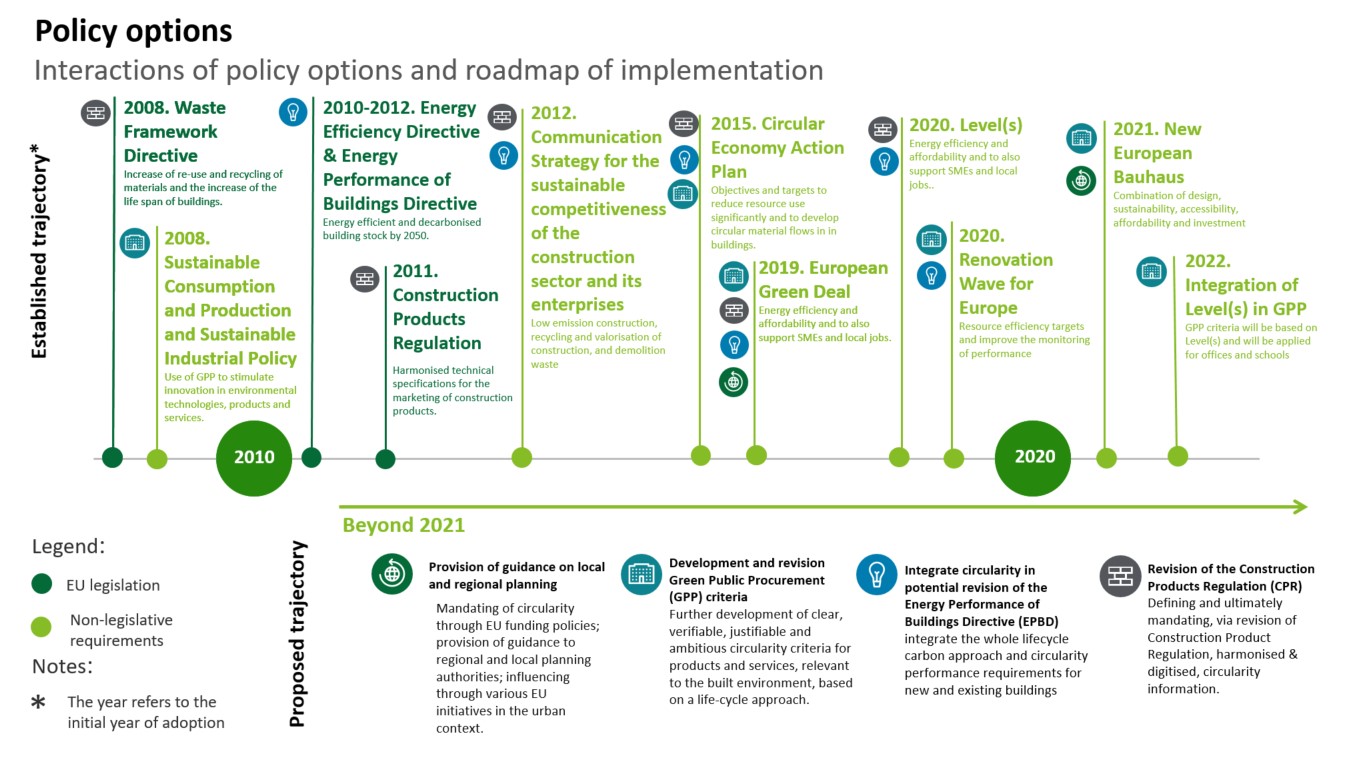
This study aims to assist the European Commission to identify policy options that support the uptake of circular economy principles for buildings’ design in European, national and local policies.
The goal is:
to increase the service life of buildings
to facilitate the use of secondary materials and
to improve resource efficiency across the building life cycle.
The study also provides key insights and recommendations on actions for a roadmap supporting the uptake and implementation of circular economy principles for buildings’ design.
Ethical smartphones, multifunctional strollers, remanufactured milking robots and bicycles-as-a-service: the Dutch manufacturing industry offers plenty of inspiring and groundbreaking innovations for a circular economy. International cooperation is nonetheless crucial to deliver and accelerate the circular transition as the value chains of the manufacturing industry cover the whole world.
With this publication, Holland Circular Hotspot and the Dutch Circular Manufacturing Implementation Programme (UPCM) aim to bring insights and case studies from the Netherlands to an international level, in order to inspire everyone around the world to act and kickstart circular development.