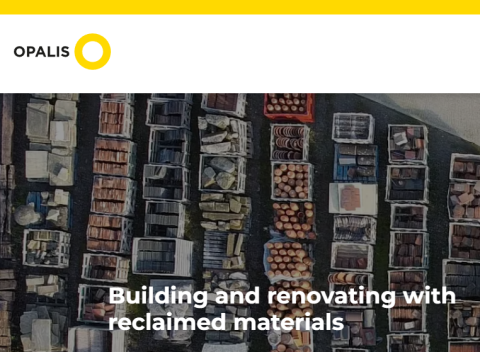
An overview of professional retailers who sell recovered building materials. These operators often offer other services as well, such as dismantling and cleaning, tailor-made components and specialised advice.
Technical documentation on the most common construction products on the reuse market.
Recent projects in which reuse materials have been applied successfully and inspiringly.
Useful documents and links for visitors who want to gather additional infomation.
Circe.med is a network of Mediterranean organisations involved in the transition towards ecologically and sustainable ecosystems. Established at the start of 2024, it wants to help deliver a carbon-free, circular economy which will improve people's quality of life.
The initiative aims to deepen, promote and implement a circular economy based on efficient and reduced use of natural resources.
Three main strands:
Sustainable food
Tourism and plastic in coastal areas
The built environment
The network's member organisations strive to deliver an effective circular economy in the Mediterranean which will benefit their individual ecosystems and the region as a whole.
The network is supported by an online platform, Circemed.org, which promotes cooperation and acts as a resource centre.
From its base in the northern Netherlands, JC-Electronics supplies new, refurbished and repaired industrial electronics. By giving used and defective devices a second life, the company contributes to the circular economy and helps customers reduce their carbon footprint.
PACCT for Sustainability aims to make service and sustainability the keystone of businesses across Europe and to build a European community focused on Product as a Service.
With the support of ADEME, Michelin, BASF and Johnston Circular, PACCT for Sustainability strives to rethink traditional economic models so as to speed up the sustainable transformation of the economy. It will do so by developing innovative business models aiming to replace an approach based on volume and products with a service geared towards customers and impact.
The platform organises webinars exploring different aspects of the sustainable economy, from value proposition to governance and financing, and workgroups where participants can co-create solutions.
This UNEP report outlines what each stakeholder group can do individually and collectively to reach the shared destination of a circular textile sector.
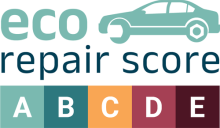
Eco Repair Score NV and VITO have developed the Eco Repair Score® to assess the environmental impact of a specific car repair job. It does this using a single score, with categories from A to E and associated colour coding.
Ambition4Circularity is a platform collecting circular commitments by large French companies. It is supported by the French Association of Large Companies (AFEP) that reflects their growing commitment to move towards a more sustainable production model.
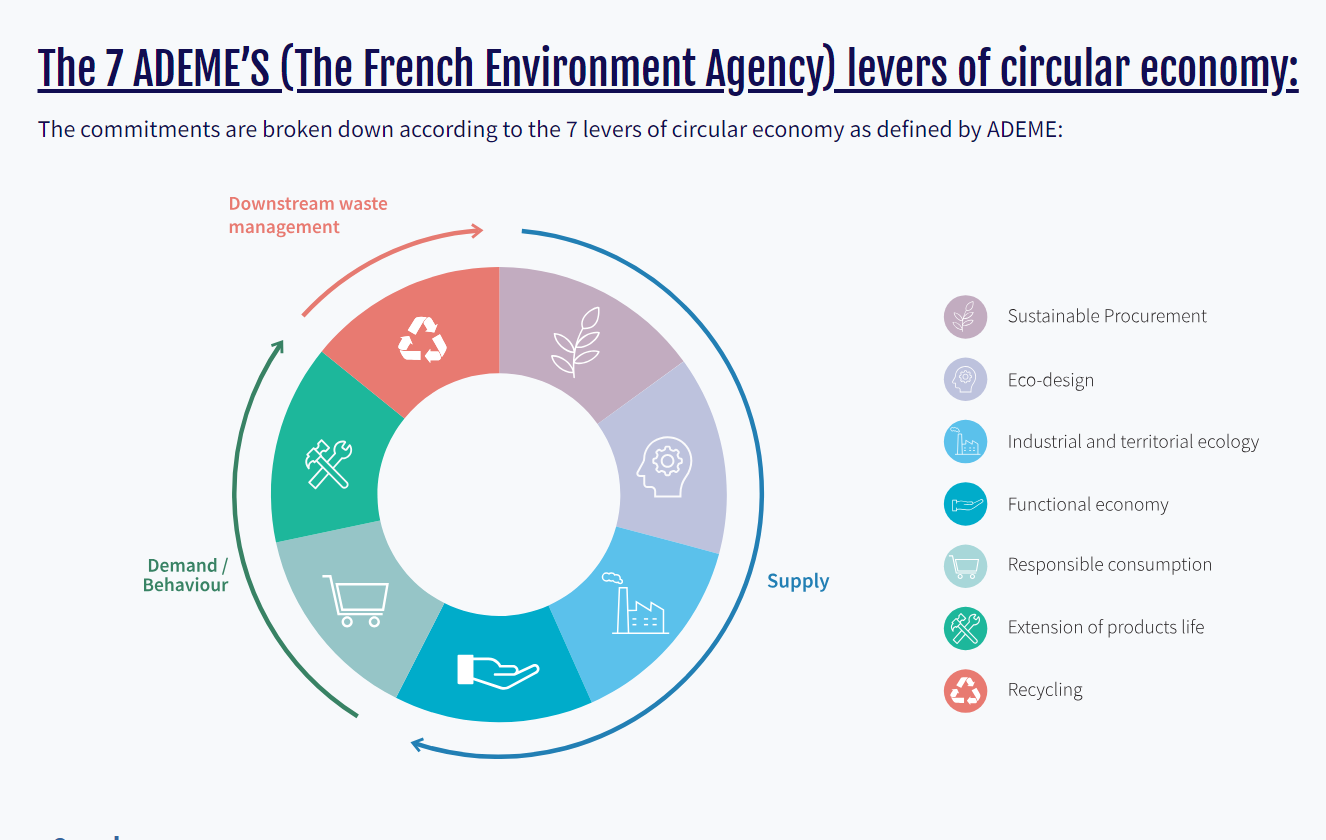
Companies have been mobilising since 2017, with a wide range of commitments to activate the seven pillars of circular economy as defined by the French Agency for Ecological Transition (ADEME) and based on their specific activities.
The commitments listed on the platform primarily involve the company’s internal stakeholders, along with suppliers, partners and customers. All aspects of the circular economy are leveraged in these commitments, from the supply of sustainable resources to the repair and recycling of the end product.
The collaborative platform Economiecirculaire.org aims to organise knowledge about the circular economy and mobilise actors at regional, national and international level (French regions, Quebec, the Canton of Geneva and the southern Mediterranean).
Created in 2014 by CIRIDD, it is intended for all professionals able to implement, encourage or support projects on this topic (local authorities, companies, developers, consultants, experts, associations, etc.). It comprises 12 regional platforms.
Eclaira is the regional collaborative platform dedicated to the circular economy in the French region Auvergne-Rhône-Alpes. Managed by CIRIDD, it aims to:
Shine a spotlight on initiatives carried out in the region
Encourage collaborative projects in the circular economy
Promote the implementation of the circular economy in the region
The platform enables users to stay abreast of circular trends and events, network, forge partnerships and join projects, use tools and tell other people what they have been doing.
It publishes technical reports and focuses on three areas: water, biodiversity and textiles, tackling each from the perspective of the circular economy. There is also a toolbox.
65% of electrical and electronic appliances put on the market must be collected after use when it turns into Waste Electrical and Electronic Equipment (WEEE). One key step in achieving that 65% is to map e-waste streams, reliably and at every stage. The BeWeee tool is designed to help companies in Belgium do so.