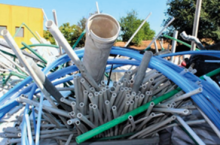
The "Waste REcycling Project" (WREP) is a pilot scheme developed by PVC Forum Italia, the national association of producers, converters and recyclers of PVC (polyvinyl chloride), in collaboration with VinylPlus, the European PVC value chain association.
It aims to make the collection, sorting and recycling of PVC waste from demolition/renovation, bulky waste and waste management centres more efficient, using a consolidated and accredited traceability methodology.
The Circular Economy Lab was set up in 2018 by Cariplo Factoryand Intesa Sanpaolo Innovation Center. It is a hub of circular economy competences that aims to help spread the principles and methods of the circular economy and support companies as they go circular.
The Lab is involved in various projects, such as the Iren Startup Award Call4Circular | Circular products and materials. It promotes the circular economy by holding workshops on key topics and by creating networking opportunities for innovative ecosystem players, such as startups, innovative SMEs, universities, research centres and technology transfer centres.
The Economy of Francesco is a platform set up upon a call from Pope Francis for young entrepreneurs, researchers and economists to work together to transform today’s economy with a view to combating the culture of waste and promoting social justice.
The initial call received over 3000 applications from 120 countries, showing that there is a whole community that feels deeply about this. Annual events are in line with the Ecology of Francesco's principles for reduced environmental impact.
EoF provides a regular programme of initiatives organised at regional or local level in the form of workshops, laboratories, seminars, conferences, round tables, calls for action and much more.
ED is a digital label providing information about the product's packaging: its components, the materials it's made of, and how to dispose of them properly.
All you need to do is scan the QR code on the packaging to get real-time, geolocated and accurate information on how to dispose of it.
Taranto Circolare is a platform that connects up companies, projects and funding with a view to fostering circular opportunities in the region.
It aims to create a network of actors that are in synergy locally, while also catering for national and international companies looking for opportunities in Puglia. It is driven by the Tondo association, which aims to develop and consolidate sustainable and circular projects in this urban area.
The platform will give companies, public authorities and organisations the opportunity to be part of a network implementing circular projects, provide specific tools and help actors measure the circularity of services and products.
Coffeefrom is an innovative project from Italy. It recovers coffee grounds from the food industry and blends them with biopolymers to form a new bio-based material that is a durable and resistant alternative to single-use plastic.
The Osservatorio Innovazione Packaging is run by the Advanced Design Unit in the University of Bologna's Architecture department.Itaims to trigger innovation in the area of packaging. It collects, prepares and provides case studies, knowledge and experience in order to promote circular, collaborative and responsible innovation projects along the packaging chain.
One of the observatory's goals is to create a regional and national "network of networks" within the packaging sector so as to foster connections between stakeholders.
The platform provides planning services, bridging research, students and businesses through talent labs and competitive projects.
There are levels of access depending on the type of membership.
Bioforcetech aims to reduce energy and labour costs while reducing emissions and generating by-products (fertilisers) with added value. The company's vision is simple: instead of transporting "waste", machines are designed to transform organic streams into renewable energy and biochar right at the wastewater plant.
NP-bioTech uses a biocatalyst, adsorbed onto an inert material (catalytic substrate). This enables the accelerated fermentation of critical biomass (such as citrus pulp or sewage sludge), transforming it into a biostabilised and pasteurised material with excellent agronomic properties.
The Hydro Ben project focuses on resource recovery for reuse in other industrial activities. It consists of recovering fatty substances from wastewater in professional catering facilities, by means of a special device which is placed under the sink.