Addressing the growing calls for a recovery response that is in alignment with other global challenges, these specifically selected opportunities all optimise the use and circulation of assets, materials and nutrients. As governments take the critical action necessary to safeguard national economies and work towards a transformation that is resilient to future global risks, the circular economy has never been more relevant.
Major Cities in Europe - like Budapest, Copenhagen, Helsinki, Ljubljana, Oslo, Prague and Tirana - have signed the European Circular Cities Declaration inviting peers to join them! The have committed themselves to leading the circular transition and to new models of production and consumption, whilst improving human wellbeing and reducing emissions.
This research reviews the long history and diversity of circularity thinking to develop a comprehensive timeline, which identifies and conceptually classifies 72 different CE-related concepts from the Global North and South alike (such as industrial ecology, Gandhian and steady-state economics, buen vivir, doughnut economics, degrowth).
In November 2020 the paper was completed with an interactive timeline that helps researchers and practitioners better situate and navigate the concept of circular economy, both in its rich historical origins and in its theoretical diversity. It thus fosters a cross-pollination of concepts and ideas which can help address the complex socio-ecological challenges of the 21st century.
To learn more about this timeline, please click here.
The Capital Region of Denmark is committed to becoming a fossil-free and circular region by 2050. Inter alia, this entails achieving an 80% recycling rate for the region’s waste by 2035, and growing green business activities by 8% by 2025. New forms of cooperation and dialogues between stakeholders are necessary to reach these goals.
Through a three-year public-private partnership, the Region and its partners aim to pave the way for greater collaboration between the waste sector and the business community. Metabolic collaborated with the Region to undertake a material flow analysis and an environmental assessment of the Region’s waste system, and to identify impact hotspots and circular opportunities.
The City of Helsinki’s Action Plan for the Circular and Sharing Economy is the updated version of the original roadmap of May 2020.
The Action Plan now extends to 2035. The focus areas are:
construction
procurement
environmental awareness and sustainable consumption.
Circular economy goals and measures are assembled under each focus area. The intention is to achieve the goals gradually.
Progress will be monitored using the Kiertotalousvahti service (Circular Economy Watch), and reported annually in the city’s environmental report and in the annual report of the European Circular Cities Declaration.
Red Alimenta is an organisation of volunteers that collects surplus food and delivers it to people in need. The network of volunteers in different neighbourhoods of the city collects and distributes surplus prepared food from restaurants, schools or hospitals.
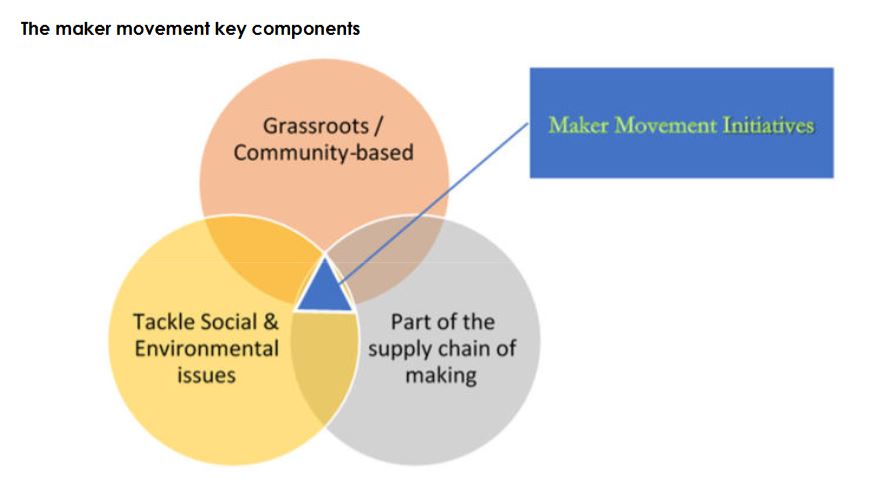
The Pop-Machina project is an EU-funded research project exploring the maker movement contributions to cities’ transition to the circular economy.
This 2nd deliverable 'Mapping the maker community ecosystem and the urban metabolism processes' draws a collection of definitions to characterise the circular maker movement. A set of original tools, including a decision tree, a taxonomy, indicators and maps of the circular maker movement are developed to delineate the circular maker movement, with a focus on the Pop-Machina seven pilot cities.
Eventually, pilot story-boards present the current status of the circular maker movement in the city, with the disclosure of the circular maker passports, characterising the movement in each pilot.
The post-COVID-19 recovery plan should be extensive, as the effects of the pandemic on people and economy have, in many cases, been devastating. The recovery plan must also fully support the green transition to guarantee resilience over the long term.
The circular economy has the potential to raise EU GDP by billions of euros, and create around 700,000 extra jobs by 2030. With this in mind, the economic approach should be an integral part of that recovery. It is one of the messages of a new EUROCITIES policy statement on the EU Circular Economy Action Plan that sets out how cities, as significant engines for economic growth, can drive the circular economy to unlock economic, environmental and social benefits.
In 2016, the Italian National Agency for New Technologies, Energy and Sustainable Economic Development (ENEA) set up a Symbiosis Users Network (SUN) to boost industrial symbiosis in Italy. The network promotes circular economy models through industrial symbiosis by focusing on operational issues.
SUN's 2019 conference was devoted to Good practices of industrial symbiosis in Italy and the contribution of regional policies as a strategic lever. The event, co-organised by SUN, Ecomondo and ENEA was held in Rimini (IT) on 7 November 2019 at Ecomondo - a leading event in Europe for new circular economy models.
Reports on ENEA-promoted conferences on industrial symbiosis are available here.